
How can we effectively renovate millions of buildings to meet climate goals? How can cities assess urban regeneration and climate-adaptation policies, improve indoor air quality and summer comfort, and prepare for heatwaves and other extreme events? At the HiDALGO2 clustering event, Christophe Prud’homme, Professor at the University of Strasbourg and leader of the Urban Buildings pilot, unveiled a massive-scale simulation framework designed to “Map, Model, Simulate, and Capitalise” urban energy usage.
The building sector is one of the largest contributors to greenhouse gas emissions and energy consumption in Europe. While EU policies demand aggressive renovation strategies, the challenge lies in scale: Which buildings and districts should be prioritised, which renovation or adaptation strategies should be deployed, and what impacts can be expected at building, district and city scales?
The answer lies in the Ktirio Urban Building (KUB) pilot, a sophisticated solution to complex urban physics that leverages EuroHPC supercomputing to bridge the gap between individual building comfort and city-wide energy planning. Ktirio helps prioritising renovation, by offering a large spectrum of functionalities. It provides dynamic building-level diagnostics and makes it possible to compare renovation, urban regeneration and climate-adaptation scenarios across individual buildings, districts and cities. Vegetation is also considered in the modelling, at different levels of details, making the environment of the building more accurate, alongside renovation, shading, materials and building use.
The presentation of Christophe Prud’homme is available here, while more technical information on this pilot are available on the dedicated pilot webpage here.
The Ktirio Framework
Ktirio is designed to simulate energy consumption from a single building level up to a city scale and beyond. Its strength lies in its multiscale approach:
– Temporal: Simulations range from minute-by-minute indoor air quality and comfort checks to year-long energy consumption projections.
– Spatial: The tool bridges the gap between regional weather models (1-km resolution) and meter-level microclimate conditions within specific city streets.
– Data-Driven: By utilising open vector databases and Open-Meteo data, the framework can reconstruct urban environments from anywhere in the world, supplemented by a country-based building database.
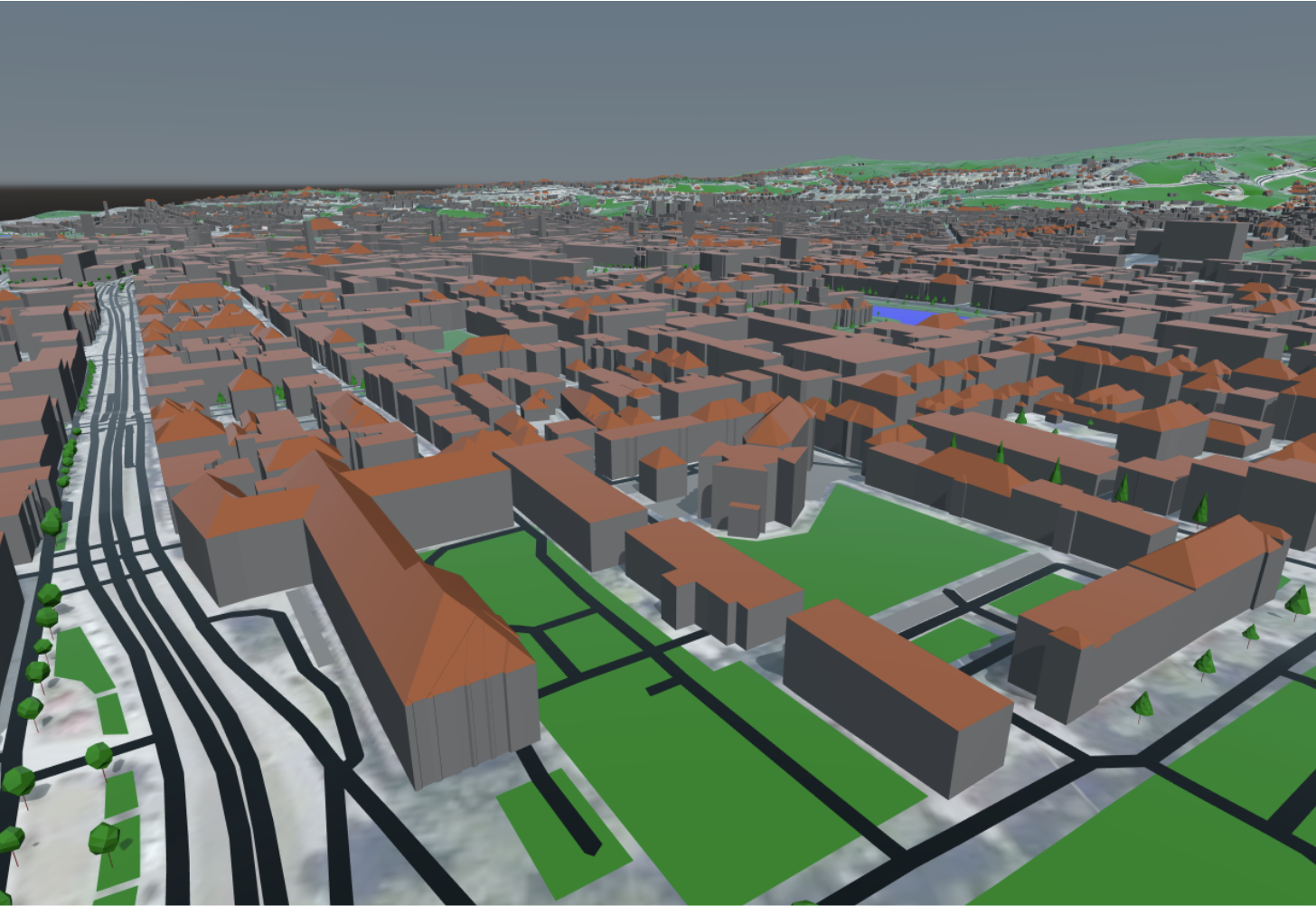
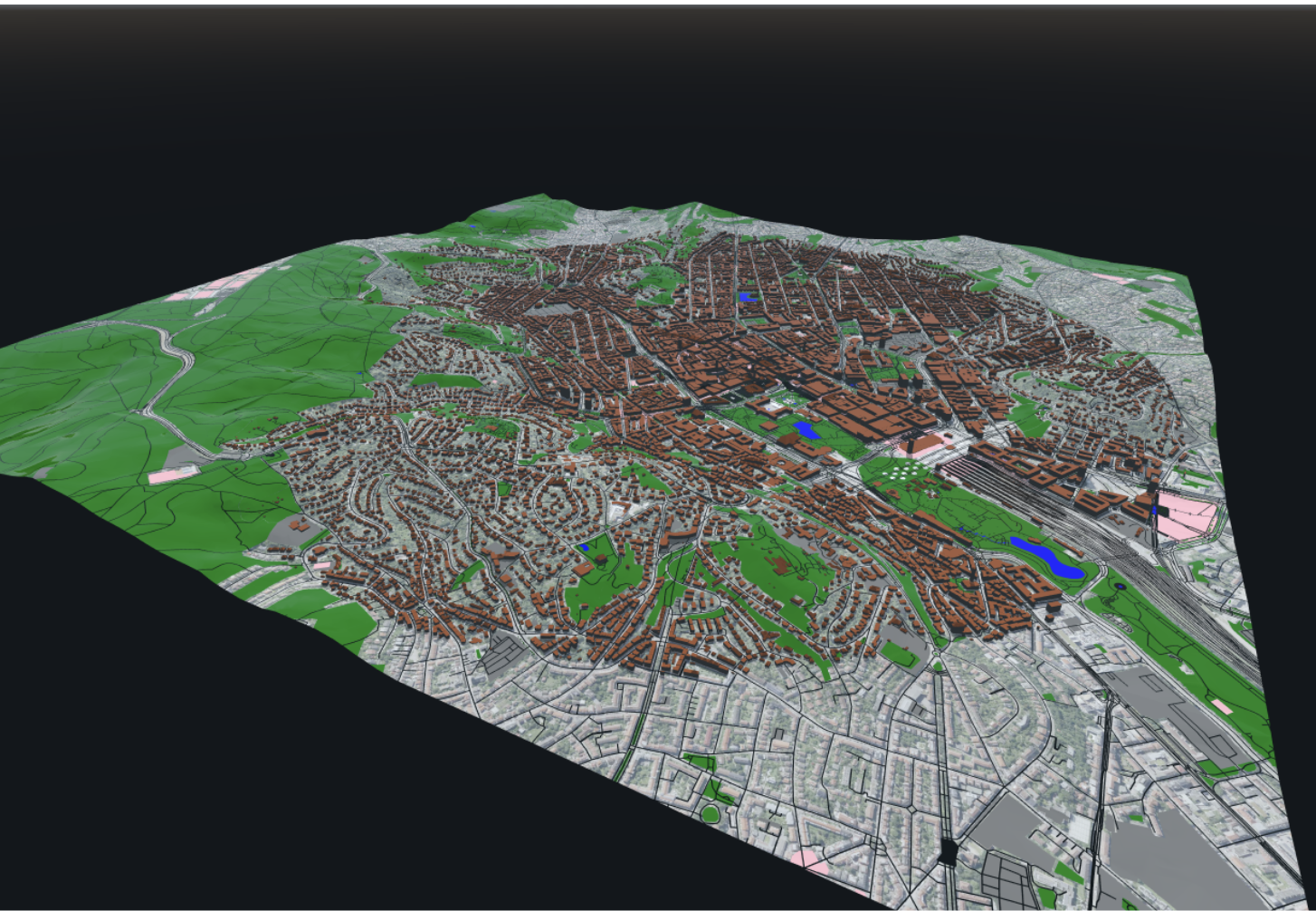
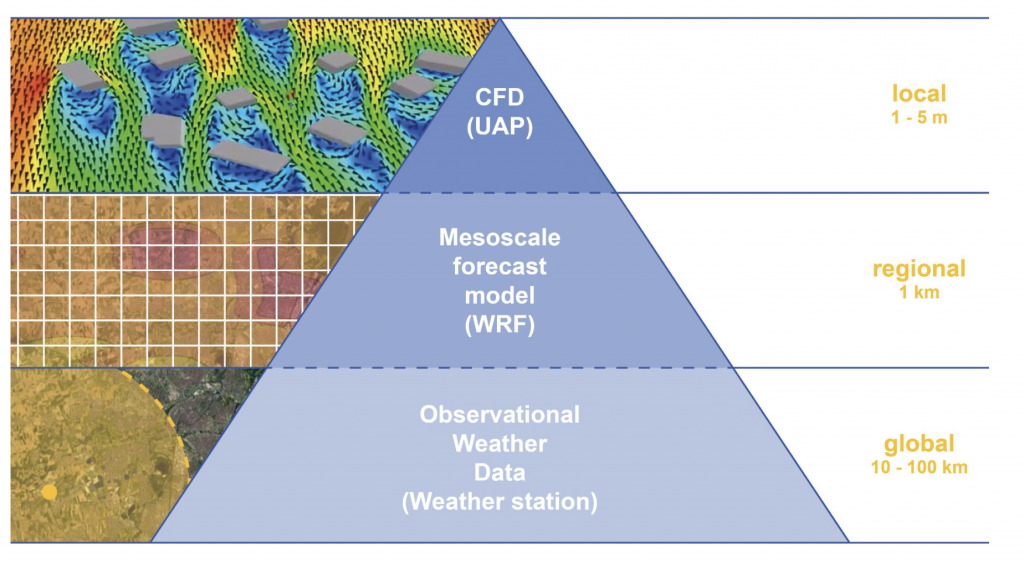
Scaling these simulations to hundreds of thousands of buildings (for entire cities or countries) requires the immense power of EuroHPC systems, such as Deucalion and Leonardo. This HPC integration allows experts to assess how heatwaves, cold spells, and future climate conditions may affect energy demand, indoor air quality and occupant comfort.
HPC is required not only to scale simulations to entire districts and cities, but also to handle complex urban geometries, dynamic multi-zone building models, long simulation periods, and large ensembles of renovation and climate-adaptation scenarios. This also makes it possible to assess the sensitivity of the results to uncertain building, usage and weather data. Wildfires and extreme pollution events are currently not supported as event scenarios in our workflow, but could be added if needed.
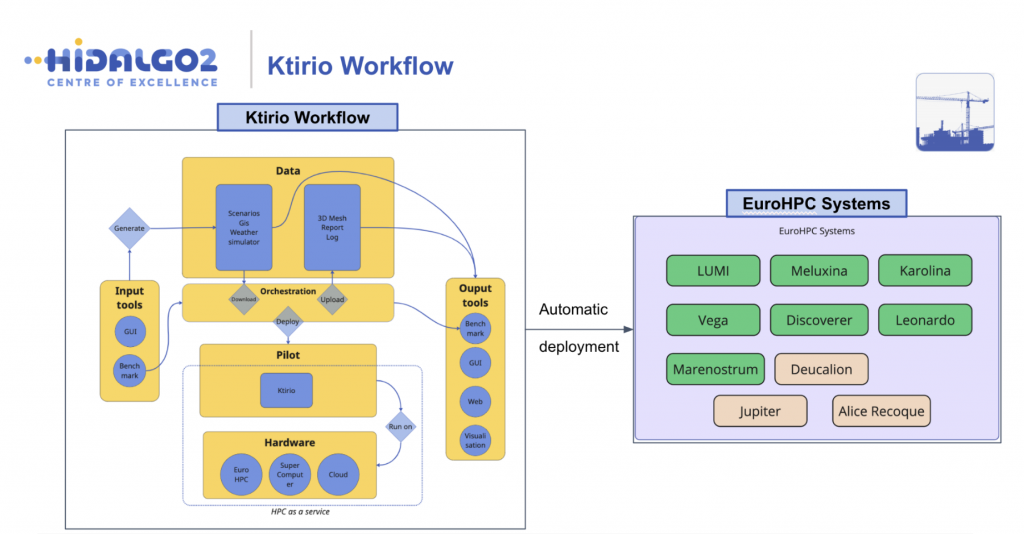
The Ktirio technical workflow is an automated end-to-end pipeline, to deploy its framework from mesh to KPIs:
1. Data Selection: Users select an area of interest via a Graphical User Interface (GUI).
2. Urban Model Generation: The platform reconstructs the building stock and its geometry from available geospatial data, associates buildings with physical and usage models, and prepares the computational cases.
– Partitioning: To ensure scalability, the computational load is distributed over thousands of cores.
– Simulation: The engine computes dynamic energy demand, indoor temperatures and comfort indicators, solar exposure, and indoor air-quality indicators such as CO₂ or pollutant concentrations.
3. Output: Automated reports provide urban planners with visualisations on key performance indicators (KPIs) regarding energy efficiency and occupant comfort.
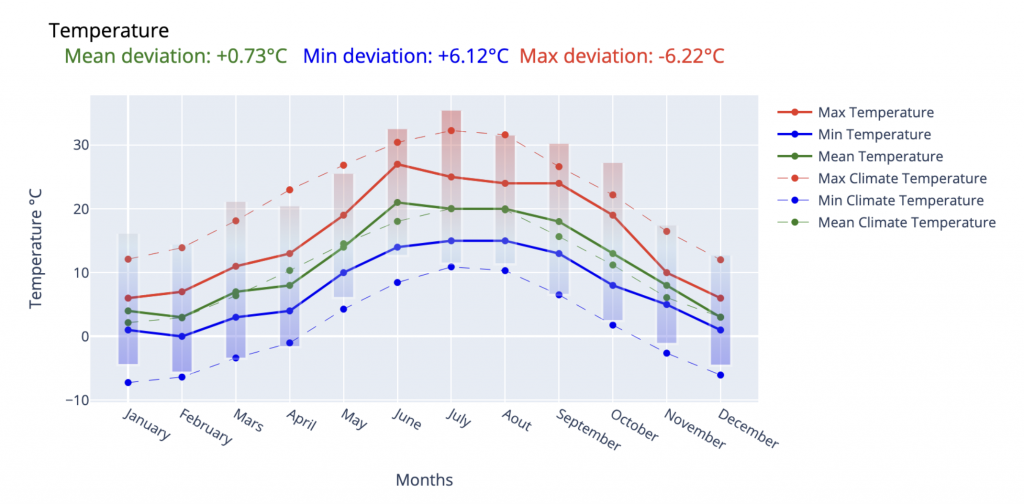
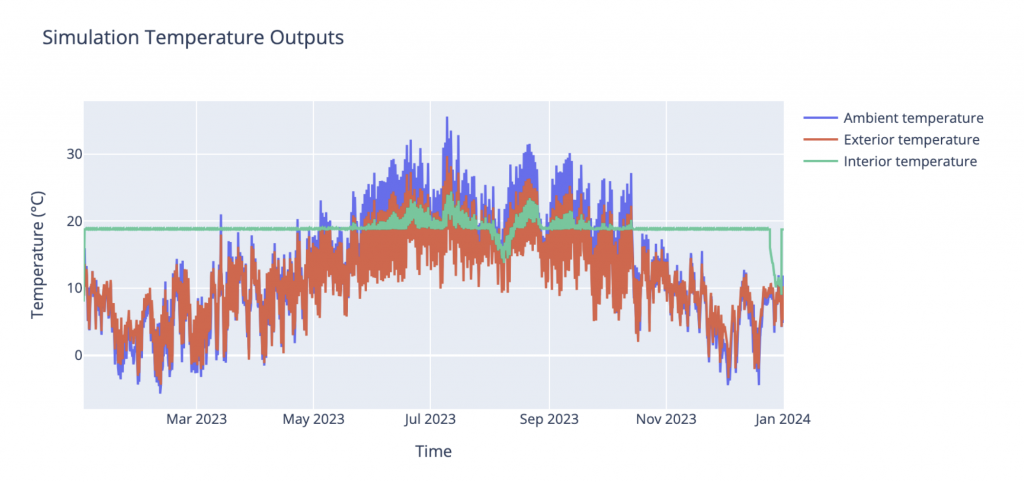
The models have been verified against established reference benchmarks and are being validated against measurements collected in instrumented buildings.
Future Horizons and user community
The transition from a research pilot to an operational platform is being guided by a strategic roadmap developed with key user groups—including local authorities, social housing providers, engineering firms and building portfolio managers. Through proof-of-concept projects, this early-adopter community will help shape the platform on the basis of concrete use cases and operational feedback.
Industrial Readiness
The transition from a research pilot to an operational platform is already underway, with a roadmap focused on external access, proof-of-concept deployments, user-oriented interfaces, and the definition of sustainable exploitation and service models.
– Broadening Access: By the end of 2026, the team aims to complete three major proof-of-concept projects with institutional and private partners, establishing a first community of Ktirio users and early adopters.
– Commercial Strategy: The team is currently discussing commercial licensing and subscription-based service models, trying to maintain a balance between access to the open science produced and commercial deployment of the project results.
– Enhanced Visualisation: Future updates will integrate the full workflow within a single GUI, moving beyond specialised tools like ParaView to provide user-oriented dashboards that allow planners to “walk” through simulated districts and view interactive exploration of simulation results and key performance indicators.
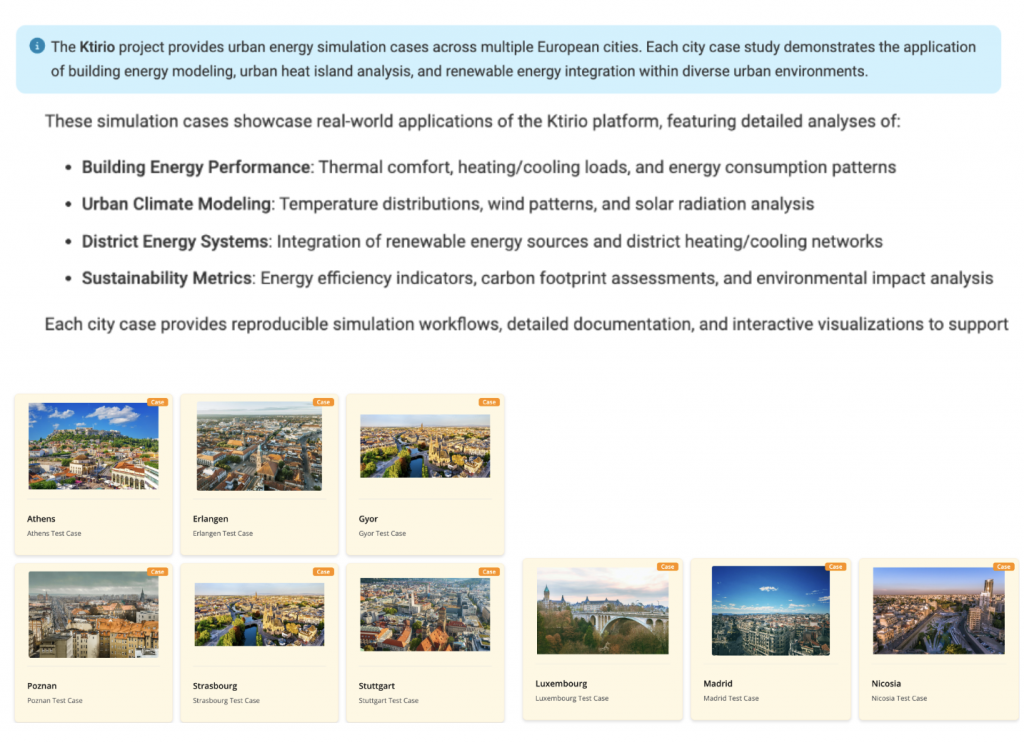
By providing a transparent, reproducible and data-informed approach to comparing buildings and intervention scenarios, Ktirio can help decision-makers prioritise investments according to their expected energy, comfort and climate-resilience impacts.
Ηοwever as the pilot leader Christophe Prud’Homme explains,
“Simulation does not replace on-site expertise. It helps experts identify where detailed investigations are most needed, prioritise interventions and plan them over time.”
About the Authors
Christophe Prud’homme, Director of the Cemosis platform, serves as the scientific coordinator and pilot lead, supervising code development, actively contributing to the software, and coordinating tool deployment. The core simulation code is driven by a dedicated team of research engineers with complementary major contributions: Vincent Chabannes focuses on user interfaces, geometry, and model implementation; Javier Cladellas handles benchmarking, meshing, and geometry; Gwennolé Chappron specialises in building thermal physics models; and Philippe Pinçon manages the integration of physical models and cross-pilot coupling. Finally, Juliette Antonczak oversees project management and partnership development, executing the strategic roadmap for the exploitation of the deployed tool.
This article was curated and designed by the Future Needs team, Kyriaki Daskaloudi and Georgia Nikolakopoulou, leading the Outreach, Awareness, and Impact Creation for the HiDALGO2 Centre of Excellence, under the overview of the pilot leader Christophe Prud’Homme.
Learn more about HiDALGO2: hidalgo2.eu
Follow the project: LinkedIn | X (Twitter)