
As the European Union pushes toward its ambitious climate targets, the transition from fossil fuels to renewable energy sources (RES) has moved from a distant goal to a daily reality. In 2023, renewables accounted for 46.9% of the EU’s electricity production, already surpassing the 2030 target of 42.5%. However, this shift introduces a significant technical challenge: variability.
Unlike traditional power plants, wind and solar energy depend entirely on fluctuating weather patterns. To stabilise the power grid and ensure a reliable supply of electricity for society, we require high precision in weather forecasting and energy production modelling.
The HiDALGO2 Center of Excellence is addressing this challenge through its Renewable Energy Sources pilot. Below, Michal Kulczewski from the Poznań Supercomputing and Networking Center (PSNC) presents the technical framework and the RES toolkit designed to bridge the gap between complex atmospheric physics and practical grid management.
For a more detailed look at the technical architecture, you can download the full presentation PDF here and visit the dedicated Renewable Energy Sources webpage.
The Challenge: From Global Weather to Local Micro-phenomena
The primary obstacle for Distribution System Operators (DSOs) and plant managers is the “weather gap.” If the sun doesn’t shine or the wind doesn’t blow, the grid faces an immediate deficit. Conversely, overproduction can strain infrastructure. To solve this, the HiDALGO2 pilot utilises a multiscale modelling approach.
Standard weather forecasts often run at a resolution of 5km to 25km. However, local urban landscapes or specific topographical features can create micro-phenomena that significantly alter energy output. The RES toolkit bridges this by coupling models across different scales:
1. Regional Scale: Utilising WRF (Weather Research and Forecasting) models up to 100m spatial resolution.
2. Urban Scale: Implementing the EULAG model to capture local variabilities at a 10-meter spatial resolution.
Exascale Computing for Non-HPC Users
A core objective of HiDALGO2 is to democratise access to High-Performance Computing (HPC). Traditionally, running simulations that quantify weather uncertainties requires immense expertise. To provide an accurate “uncertainty quantification,” a single forecast job might involve ensembles that require tens of thousands of CPUs.
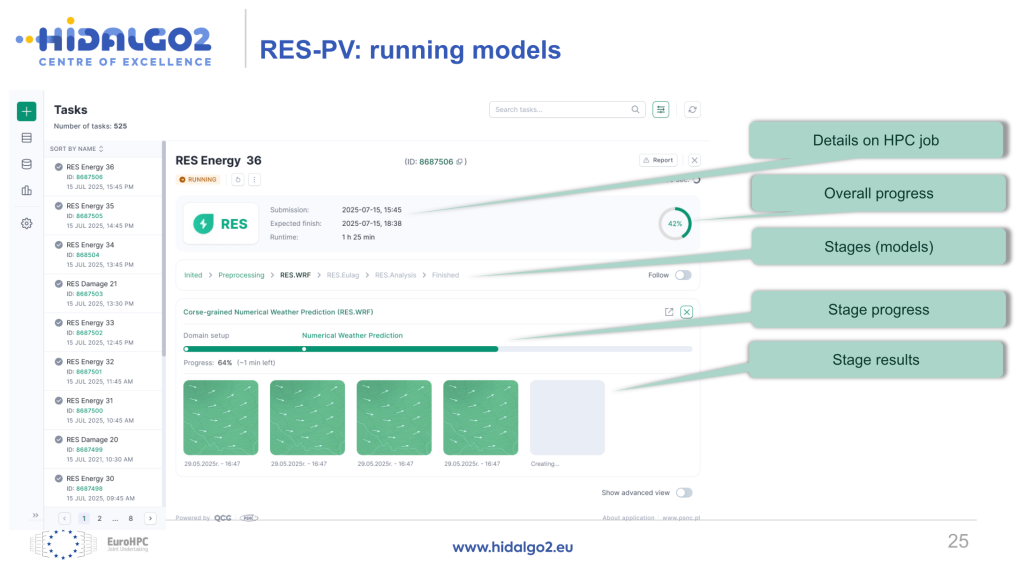
The RES Toolkit developed at PSNC removes these technical barriers through the QCG (Quality of Service Grids) middleware and mUQSA toolkit. QCG-Portal is an adaptable portal for the execution of various computational scenarios on remote resources. It provides a transparent web interface where users—such as wind farm developers or PV operators—can:
– Define regions of interest using a simple, customisable Graphical User Interface(GUI).
– Automate horizontal resolution and time-step calculations.
– Monitor HPC job stages and progress without writing a single line of code.
The mUQSA toolkit, developed by Bartosz Bosak from PSNC, brings advanced methods for Uncertainty Quantification and Sensitivity Analysis of scientific applications through the user-friendly web portal.
AI-Enhanced Precision: The RES-PV Service
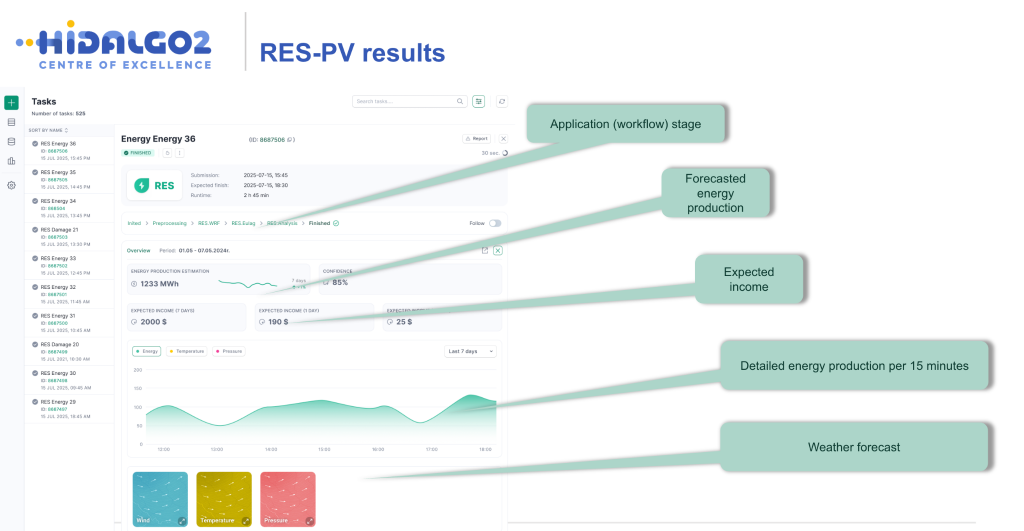
Beyond physics-based modelling, the pilot integrates Artificial Intelligence to refine accuracy. The RES-PV tool, developed by Wojciech Stefaniak from PSNC, specifically targets photovoltaic energy production. By employing Recurrent Neural Networks (RNN) and the PyTorch framework, the system analyses 12 meteorological parameters—including radiation, visibility, and temperature—to predict electricity output.
Validation is performed using a real-world 1Wp solar farm located near the PSNC headquarters. This “ground truth” data allows the AI model to capture the complex relationship between atmospheric conditions and actual energy yield more effectively than standard linear models.
Learn more about the technical details and code used for these tools on our dedicated webpage here.
Impact on Policy, Industry, and Society
The implications of the RES toolkit extend beyond the research community:
For Industry: PV and wind farm operators can provide more accurate price bids to energy stock exchanges, reducing financial risk and improving efficiency.
For Policy Makers: High-fidelity modelling provides the evidence base needed to design resilient energy grids and meet European Green Deal directives.
For Society: It ensures that as we move toward green energy, the stability of the grid remains uncompromised—ensuring that the electricity is there when we need it, regardless of the source.
About the Authors
This article was developed by the Future Needs team (Kyriaki Daskaloudi and Georgia Nikolakopoulou), who lead the outreach and impact creation for the HiDALGO2 project. Future Needs organised the HiDALGO2 Clustering Event at the High-Performance Computing Centre Stuttgart (HLRS), managed the production of the technical video series, and oversees the dissemination of the project’s scientific breakthroughs to the wider European HPC community.
For more information on the project’s impact, follow HiDALGO2 on LinkedIn and X (Twitter).