
Translating complex high-performance computing (HPC) simulations into actionable decisions for real-world environmental challenges requires intuitive tools. Urban planners, disaster management teams, and industrial stakeholders need direct access to advanced predictive models without spending weeks mastering cluster-level software environments.
With the release of Deliverable 2.9 (D2.9): HiDALGO2 Dashboard and Services, the European Centre of Excellence HiDALGO2 introduces a streamlined operational gateway connecting non-technical decision-makers and HPC specialists to supercomputing workflows.
1. Real-World Environmental Pilots
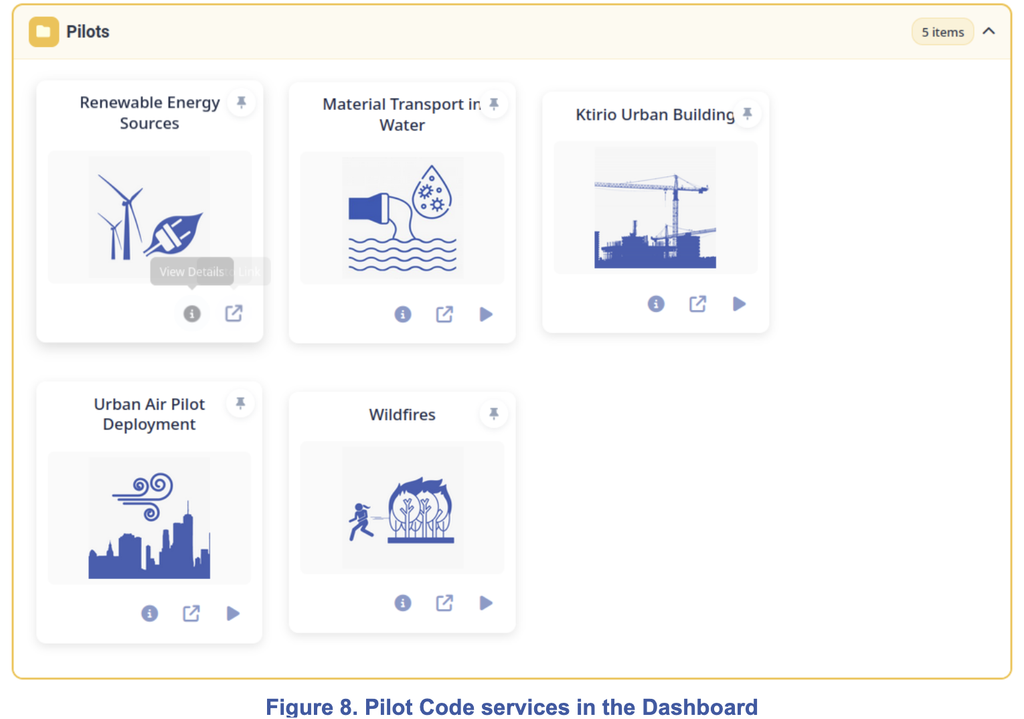
The HiDALGO2 Dashboard acts as a central control hub for five pilot applications designed to solve urban and environmental challenges:
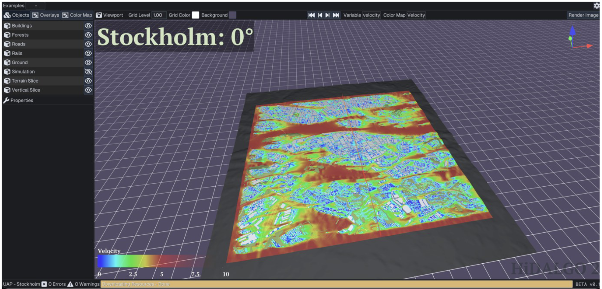
– Urban Air Pollution (UAP): Simulates micro-climate airflow, wind comfort, and pollutant dispersion across cities like Stockholm using computational fluid dynamics engines (RedSIM, Xyst, OpenFOAM).
– Urban Building (UB / Ktirio): Evaluates building energy efficiency, thermal comfort, and greenhouse gas emissions at city scale to support net-zero targets.
– Renewable Energy Sources (RES): Generates high-resolution wind and solar energy yield forecasts to help grid operators optimise power generation.
– Wildfires (WF): Simulates real-time wildfire propagation and toxic smoke dispersion (WRF-Sfire) to assist emergency response teams during critical ignition events.
– Material Transport in Water (MTW): Models fluid-particle dynamics and thermal energy transport within aquatic systems to track contamination and water quality.
2. Bridging the Gap: Designed for Stakeholders, Powered by HPC
For municipal officials, industrial operators, and policy analysts, the HiDALGO2 Dashboard eliminates technical barriers to high-performance computing:
– Single Sign-On (SSO): A single Keycloak authentication account provides instant, secure access to all consortium services, visualization tools, and datasets.
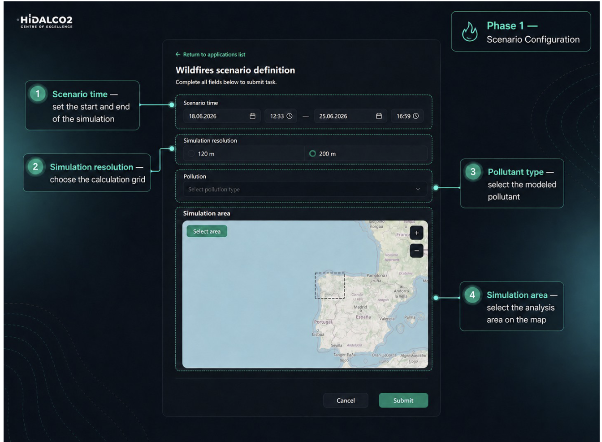
– Interactive Map-Based Setup: Stakeholders can draw simulation bounding boxes directly over map interfaces to define risk zones or urban areas.
– No-Code Configuration: Input forms automatically generate complex execution payloads (such as JSON grid coordinates and Slurm scheduler parameters) behind the scenes.
– Automated Visual Results: Once a run completes, results are converted into 2D heatmaps, animated playback loops, and 3D web graphics (CFDR/ParaView) instead of raw text logs.
3. Under the Hood: The Technical Architecture
For developers, computational scientists, and HPC administrators, Deliverable 2.9 establishes a robust microservices infrastructure:
Key Technical Specifications
– Orchestration Blueprints: Pilot workflows are defined as TOSCA-style YAML templates in MathSO (UAP, UB, MTW) or dynamic JSON execution templates in QCG (RES, WF).
– Data Pipelines: Integrated with CKAN repositories and the HiDALGO2 Data Transfer Library to move geometry, weather forcing data, and simulation outputs between storage spaces and compute nodes.
– HPC Systems: Orchestrators interface directly with European supercomputing sites (e.g., LUMI, Leonardo, MeluXina) using automated Slurm workload submissions (srun/sbatch).
4. What’s Next?
Deliverable 2.9 confirms that the HiDALGO2 ecosystem is operationally ready for consortium-internal workflows and controlled external pilot demonstrations. Ongoing refinements focus on expanding guided user onboarding, adding direct debugging options for blueprint developers, and incorporating expanded system-level HPC monitoring tools.
Explore the HiDALGO2 Platform
Try the Portal: Access the live environment at dashboard.hidalgo2.eu.
Read the Deliverable: Download D2.9 on Zenodo (Record 21070896).
Deliverable 2.9 was authored by László Környei (Széchenyi István University – SZE) with contributions from ATOS, PSNC, SZE, USTUTT, UNISTRA, ICCS, MeteoGrid, and FAU.