
David Caballero, david@meteogrid.com
Forestry Engineer (UPM). Consulting Collaborator at MeteoGrid S.L., Spain. Editorial Contributor to RIyRN.
The Problem: Simulating Fire with Physical Rigour
A wildland fire is not just a visible flame. It is an integrated system of heat transfer, solid fuel combustion, atmospheric turbulence, and gas emissions interacting in fractions of a second and across centimetre scales. The operational modelling tools currently deployed in emergency management vastly simplify this complexity: they calculate quickly, but at the cost of assuming the forest is homogeneous, that wind blows uniformly, and that vegetation can be represented as a flat carpet of fuel models.
A radically different alternative exists. Software programs such as the Fire Dynamics Simulator (FDS)—developed by the United States National Institute of Standards and Technology (NIST)—and its extension for forest environments, WFDS, solve the complete three-dimensional physical equations of reactive flow. Forest fuel is represented as a cloud of particles with real thermophysical properties: bulk density, surface-to-volume ratio, and moisture content. Each calculation cell simultaneously resolves the stages of drying, pyrolysis, and combustion, as well as the physics of convective and radiative heat transfer and their effects on fluid variables (pressure, temperature, density, velocity, etc.). The result is a simulation that captures real fire dynamics within complex fuel distributions and evaluates potential impacts on structures.
The price of this rigour is computational cost. A simulation of just one hectare of forest at a 50 cm resolution—a modest scale for a wildland fire—requires eight million calculation cells and hundreds of processors running in parallel for hours. These computational resources are not available on a laptop or office workstation, requiring supercomputers (clusters) instead.
HIDALGO2: HPC in the Service of Wildland Fires
The HIDALGO2 project, funded by the European High Performance Computing Joint Undertaking (EuroHPC JU), was established to bring high-rigour physical simulation tools to European high-performance computing infrastructure. The goal is to make these outputs accessible and practical for land managers, researchers, and decision-makers (Caballero et al., 2025).
Within this framework, MeteoGrid has spent the past two years developing a comprehensive workflow: from generating 3D vegetation to running physical fire simulations on supercomputers, rigorously initialising fuel parameters, and rendering results in real time within immersive virtual environments.
From the 3D Tree Model to Physical Simulation
The initial technical hurdle lies in linking the detailed geometry of a tree—including branches, needles, and crown mass distribution—with the format required by FDS to simulate combustion. Traditional WFDS models simplify trees into cylinders or cones filled with uniform fuel. While practical for rapid calculations, this ignores non-uniform vegetation density. For instance, a crown’s periphery may be denser while the interior remains hollow, with fuel-free gaps around the trunk that influence ignition and spread patterns. In recent years, newer approaches have utilised 3D tree models to identify volumetric fuel distributions (Parsons et al., 2011).
Building on this approach and leveraging Unreal Engine 5 (UE5)—widely adopted today in precision scientific and architectural visualisation as well as gaming (Caballero, 2024)—a procedural content generation (PCG) pipeline was developed to construct realistic 3D trees with botanical precision (Figure 1). In these models, every needle, twig, and mesh polygon reflects realistic geometry based on species, maturity, and health status.
The core of this method is barycentric fractal discretisation (Caballero, 2026 A). The underlying problem is straightforward: given a tree model composed of thousands of 3D triangular polygons, how do you determine which cells within the FDS computational grid contain plant fuel? A naive approach—checking whether a triangle intersects a cell—systematically overestimates fuel volume by flagging cells that are only grazed by the polygon.
Instead, the proposed solution recursively splits each triangle into four smaller sub-triangles until their surface area matches the face of a calculation cell. The barycenter (centroid) of each sub-triangle then identifies the specific cell containing fuel. The process concludes once the subdivision matches the target grid resolution—hence the term “fractal,” reflecting the self-similar nature of the iterative subdivision.
The resulting Lagrangian particle distribution within FDS accurately reflects natural tree architecture: higher density along crown margins, interior voids, and open space around the trunk. For a four-meter-tall Picea abies specimen, this method generates over 18,000 fuel-bearing cells at a 5 cm resolution (Figure 1).
A key attribute of this method is its geometric scalability. Physical fuel parameters (mass density and surface-to-volume ratio) remain intrinsic species properties rather than artefacts of the computational grid. Consequently, the same botanical model and species parameters can simulate an individual tree’s combustion at a 5 cm resolution, or scale up to a landscape simulation of thousands of trees at 50 cm resolution without altering the underlying physical properties.
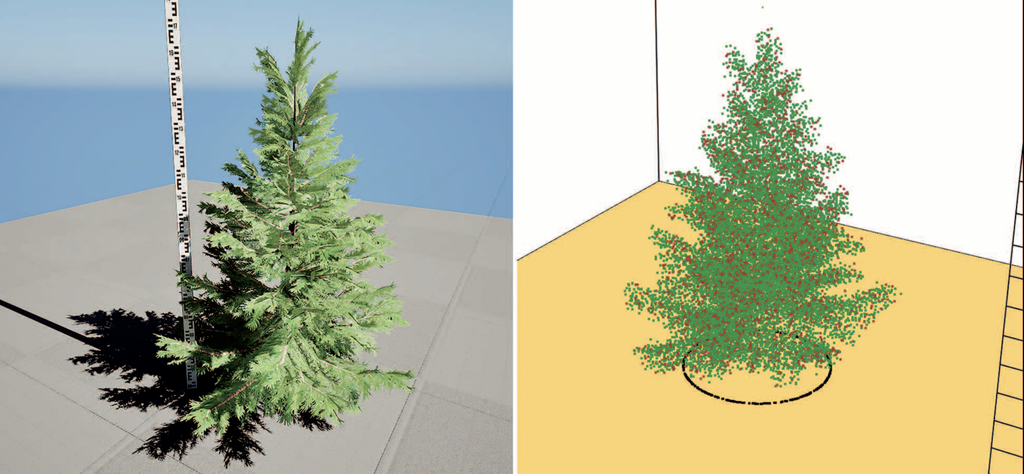
A 3D model of Picea abies (left) and its translation into Lagrangian particles (right) representing the distribution of live (green) and dead (red) fuels for use in FDS. Author: David Caballero]
This entire pipeline is integrated into UE5 as a native C++ plugin (FDS Vegetation Exporter v3.2). The user procedurally generates vegetation inside the editor, selects species and resolution settings, and exports a production-ready FDS case with a single click for deployment across the EuroHPC supercomputing network. The methodology has been validated against real-world test cases, including a one-hectare simulation in the Rectoret wildland-urban interface (Barcelona) containing 4,490 individual trees mapped across a digital elevation model (Figure 2). This workflow streamlines the creation of complex wildland-urban interface scenarios while harnessing the high-performance computing power of EuroHPC (Caballero et al., 2026 C).
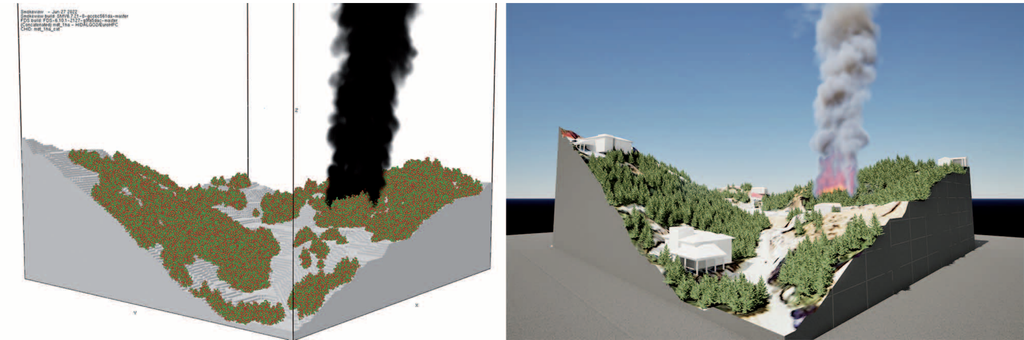
Example of Lagrangian particle distribution and wildfire simulation in FDS as rendered in Smokeview (left) compared to the same output exported into Unreal Engine 5 (right). Author: David Caballero]
The Visible Result: Real-Time Visualisation
An FDS simulation outputs hundreds of gigabytes of volumetric data, detailing gas temperatures, soot concentrations, and water vapour mass fractions across every cell and time step. While FDS’s standard visualizer, Smokeview, offers functional data inspection, it is not well-suited for firefighter training, public risk communication, or interactive scientific dissemination.
The developed workflow addresses this limitation by establishing a pipeline that processes raw binary FDS output directly into physically based, real-time visualisation within UE5 (Caballero, 2026 B) across three distinct steps:
– VDB Conversion: Volumetric files generated by FDS are converted to OpenVDB format, an open standard for sparse volumes used in visual effects and scientific analysis. A custom multi-threaded Python converter processes hundreds of frames in parallel, utilising all available CPU cores on an HPC node. For instance, a 971-frame simulation converts in under three minutes on a 128-core node. This step also reduces simulation export files by orders of magnitude, simplifying data transfers from the supercomputer to local visualisation workstations via FTP.
– Sparse Volume Textures (SVT): The VDB files are imported into UE5 as Sparse Volume Textures, the engine’s native system for handling volumetric data. Each file contains three physical channels: soot density, gas temperature, and water vapour mass fraction.
– Physical Optical Shading: A custom volumetric material translates these physical variables into distinct optical behaviours: soot density governs light extinction and scattering (producing visible smoke plumes), while gas temperature drives thermal blackbody radiation. This produces realistic light emission, transitioning from dull dark red around $500^\circ\text{C}$ to bright yellow-white above $1,400^\circ\text{C}$. The final render is not an artistic approximation, but a physically grounded representation of fire behaviour computed in real time.
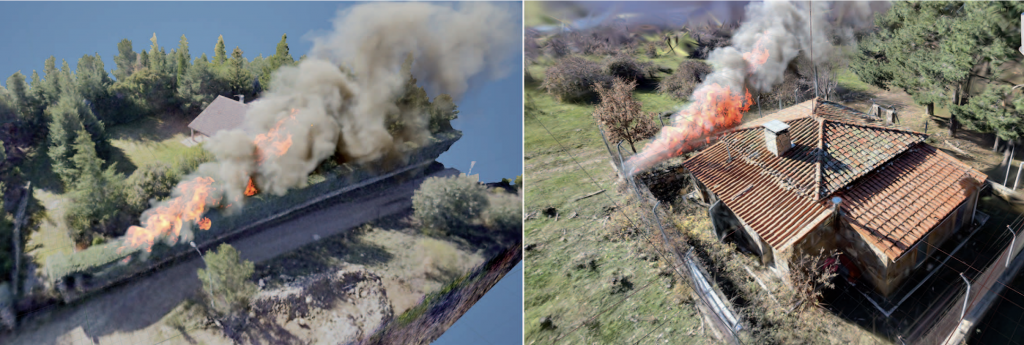
An added feature is its integration with photogrammetric reconstructions of real-world terrain using Neural Radiance Fields (NeRF). The simulated wildfire can be composited directly over drone-captured 3D terrain models. This configuration maintains accurate physical occlusions and depth handling between simulated smoke plumes and real geometry—an advantage over 3D Gaussian Splatting (3DGS), which can struggle with volumetric depth layering. This capability allows simulated fire behaviour to be mapped directly into real geographic landscapes (Figure 3).
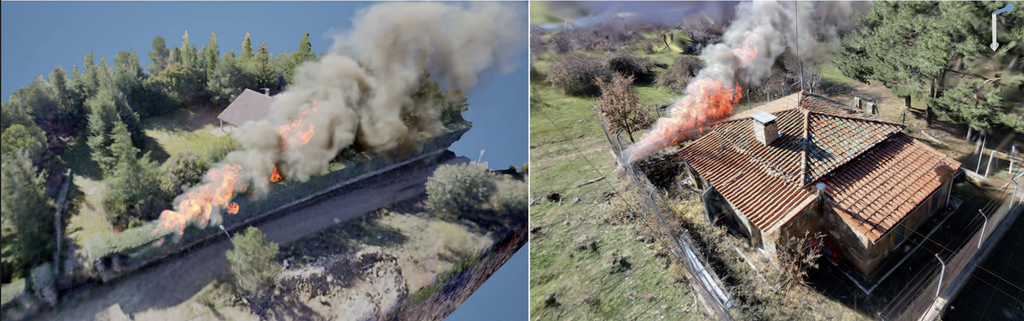
Integration of volumetric smoke and flames with NeRFs (left) and 3DGS (right), highlighting the strengths and limitations of each approach for use in immersive environments. Author: David Caballero]
Application Potential
These methodologies are currently operational on production infrastructure, supported by validated test cases and stable implementation pipelines. They offer practical utility across several domains:
– Scientific Research: Enables detailed analysis of how distinct tree architectures—rather than idealised geometric shapes—affect fire behaviour, including crown ignition thresholds, rate of spread, and the role of fine-scale spatial fuel heterogeneity.
– Risk Management: Facilitates wildfire scenario simulations across real wildland-urban interface (WUI) landscapes populated by terrain and vegetation models, providing decision-support tools to design fuel breaks, plan defensible space, and evaluate silvicultural fuel treatments.
– Operational Training: Provides interactive real-time visualisation within a game engine, delivering an immersive environment for incident commanders and emergency managers that surpasses pre-rendered animations.
– Public Communication: The ability to demonstrate fire behaviour across familiar local terrain under specific weather conditions serves as a communication tool for public awareness and community support of preventive forestry.
Next development phases include expanding the library of Mediterranean species (Aleppo pine, stone pine, holm oak, cork oak, and various deciduous oaks), validating models against field burn experiments with measured tree architecture, and scaling up to landscape domains covering several hundred hectares using European supercomputing capacity.
This work was carried out within the framework of the HIDALGO2 project, funded by the EuroHPC Joint Undertaking (Grant Agreement No. 101093590), utilising computing time on the LUMI (CSC, Finland) and MeluXina (LuxProvide, Luxembourg) supercomputers.
Read it in Spanish below on pages 11-13