
Part 1 of a four-part white paper series explains how to identify and select Key Exploitable Results (KERs) in European research projects.
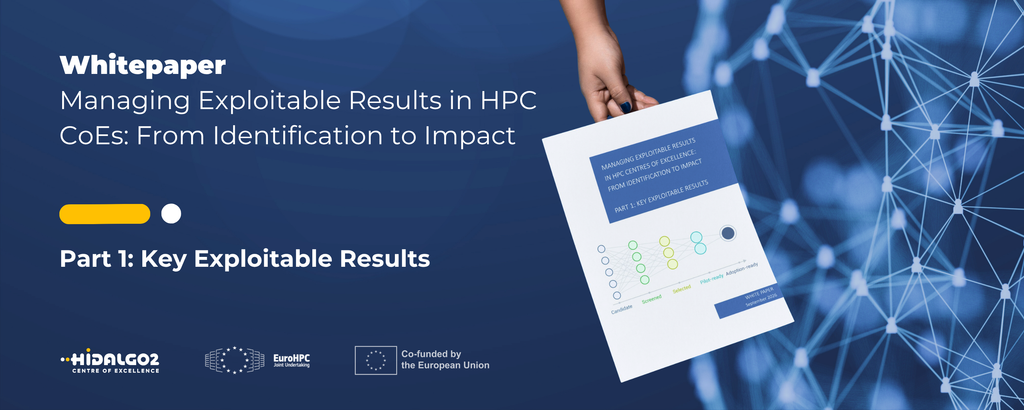
Europe’s High Performance Computing (HPC) Centres of Excellence (CoEs) produce world-class science and software, yet many valuable results remain underused once a project ends. To help close this gap, a taskforce of professionals from six CoEs has published “Managing Exploitable Results in HPC Centres of Excellence: from Identification to Impact – Part 1: Key Exploitable Results“, the first of four white papers on how to manage research results for maximum impact. It follows the taskforce’s 2025 white paper on building commercialisation capabilities in CoEs.
The 16-page paper addresses what is often called the innovation “valley of death”, the point where promising research fails to reach adoption. Its central idea is that not every technically successful result should become a Key Exploitable Result (KER). Candidates should be identified early and screened against a minimum evidence checklist covering, among other aspects, target users, value proposition, alternatives and ownership.
In practice, the paper proposes a KER pipeline with five stages (Candidate, Screened, Selected, Pilot-ready and Adoption-ready) separated by documented decision gates. It also categorises the KERs typical of HPC CoEs, from software and workflows to data assets, services and training products, and introduces a multidimensional readiness model (technology, market, investment and societal) that the next parts of the series will develop.
The white paper is a collaborative effort by researchers, exploitation and innovation managers and communication officers from six HPC CoEs, all members of the “Sustainability Vision for CoEs Taskforce”, set up within CASTIEL-2). The authors are Richard A. Norman (Norman Consulting, BioExcel), Marcin Lawenda (Poznan Supercomputing and Networking Center, HiDALGO2), Anne-Bernard Bedouet (SICOS BW, EXCELLERAT P2), Giulia Zunino (HPCNow!, MultiXscale), Alba Abia (Barcelona Supercomputing Center, ESiWACE) and Aerton Guimarães (Barcelona Supercomputing Center, ChEESE-2P).
Aimed at CoE researchers and developers, project coordinators and innovation managers, as well as anyone taking part in Horizon Europe Research and Innovation Actions with exploitable digital results, Part 1 is the first step of a series that will continue with exploitation strategies (Part 2), readiness assessment and maturation (Part 3), and adoption, scale-up and sustainability with real CoE examples (Part 4).
Where to read it
DOI: https://doi.org/10.13140/RG.2.2.17874.93124
How to cite:
R. A. Norman, M. Lawenda, A.-B. Bedouet, G. Zunino, A. Abia, and A. Guimarães, “Managing Exploitable Results in HPC Centres of Excellence: from Identification to Impact – Part 1: Key Exploitable Results”, Sep. 30, 2026, ResearchGate. doi: 10.13140/RG.2.2.17874.93124.