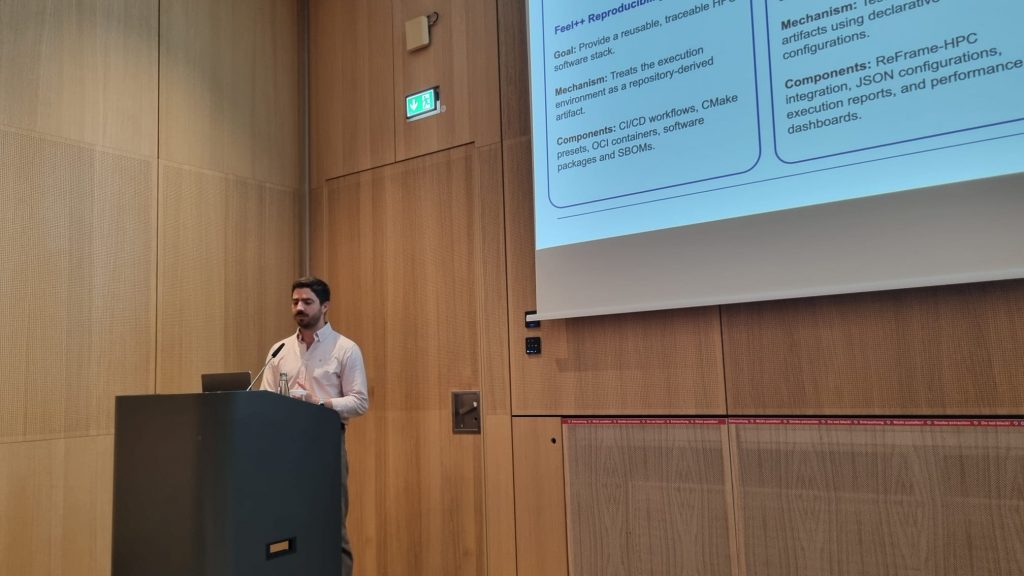
The Repro-HPC Workshop concluded on Friday 26th, 2026, and the HiDALGO2 project was there co-organising and presenting our last paper. The participants shared insights and presented cutting-edge research on one of the industry’s most pressing challenges: the reproducibility crisis.
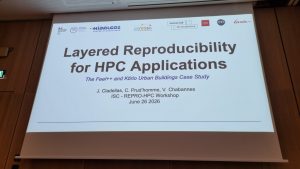
Representing the University of Strasbourg (Unistra), Javier Cladellas presented our newly published paper: “Layered Reproducibility for High-Performance Computing Applications: The Feel++ and Ktirio Urban Buildings Case Study.”
The Core Challenge: The HPC Reproducibility Gap
As supercomputers grow more complex and heterogeneous, traditional scientific validation methods fall short. In simple terms, Javier’s presentation broke down the three massive bottlenecks currently facing the HPC community:
– Portability: Supercomputers rely on vastly different hardware architectures and software environments. How do we ensure an application runs across all of them?
– Minimal Reproducible Experiments (MRE): Re-running a massive simulation pipeline to validate a code change or compare machines is incredibly wasteful. How can we re-verify results without needlessly burning core-hours and electricity?
– Traceability: Supercomputer filesystems are notoriously transient. How do we track massive volumes of input/output data and prove the authenticity of results without relying solely on local cluster storage?
The Solution: A “Layered” Verification Chain
To solve these issues, the paper introduces a robust, interconnected pipeline implemented at Unistra that ensures a simulation can be tracked flawlessly from inception to final output:
– Layer 1: Environment Isolation (Software Locking): Using containers (Apptainer/Singularity and Docker), the entire software stack is tightly locked. This guarantees that the execution environment remains perfectly identical, no matter which supercomputer hosts the simulation.
– Layer 2: Automated Testing & Continuous Integration: By constantly running rapid, small-scale experiments, the team ensures the code behaves as expected and that performance is maintained. This continuous integration flags bugs and performance regressions early in the development cycle before wasting massive computing allocations.
– Layer 3: Digital Footprints for Data: Simulation results are strictly coupled with their exact inputs and tied to the specific version of the code that generated them, ensuring data doesn’t live and die on a localized cluster filesystem.
💡 The Main Takeaway: True reproducibility requires more than just throwing an application into a container. It demands a fully automated, traceable chain that rigidly links the source code, the testing environment, and the final verified data.
Aligning with HiDALGO2 Deliverables
This research is deeply integrated into the core architecture of the HiDALGO2 project. For those interested in diving deeper into the technical mechanics behind our presentation:
– Continuous Benchmarking: The methodology behind our automated performance checks utilizes the Feel++ benchmarking framework, which is detailed extensively in Deliverable D3.2.
– CI/CD & Data Management: The technical setup of our automation pipelines and data orchestration workflows can be found in Section 5.3 of Deliverable D2.6.
Beyond Javier’s presentation, the HiDALGO2 technical manager Abdulatif Eymash and our partner Dennis Hoppe were on the ground presenting their work and actively participating in the discussions. The workshop was a major success, sparking valuable discussions on how to fully automate deployment processes across diverse HPC infrastructures—a key milestone as we move toward a fully automated “Push-to-Reproduce” workflow.
Thank you to the organizers of Repro-HPC and to everyone who stopped by Hall X8 to collaborate with us!