
As climate change intensifies, the nature of wildfires is undergoing a fundamental shift. They are no longer merely landscape events but have become complex atmospheric phenomena—often described as the “atmosphere in combustion.” Addressing these high-energy, destructive events requires more than traditional observation; it demands the immense processing power of High-Performance Computing (HPC) and the precision of Digital Twins.
The HiDALGO2 Clustering Event, “HPC and Big Data Technologies Addressing Global Challenges,” held on 4 November 2025 at the High‑Performance Computing Centre Stuttgart (HLRS), brought together leading experts to tackle these environmental crises. Among the highlights was the presentation by our expert David Caballero (MeteoGrid), who detailed the project’s work on wildfire simulation, including the technical milestones of the Wildfires Pilot and its implications for global safety.
The video below, captured by the HiDALGO2 dissemination team, features not only David Caballero’s full technical presentation on multiscale modelling of fire-atmosphere interactions and impressive simulations, but also some of the societal and economic context of these dangerous phenomena.
The Wildfires Pilot is led by Luis Torres Michalena (MeteoGrid) in collaboration with a team of experts including Leydi Laura Salazar, Ángela Rivera and Jaime Ribalaygua.
Resources: For a detailed look at the methodology, you can view and download the full presentation PDF here or explore the official HiDALGO2 Wildfires Pilot page.
A Global Crisis: Beyond Traditional Firefighting
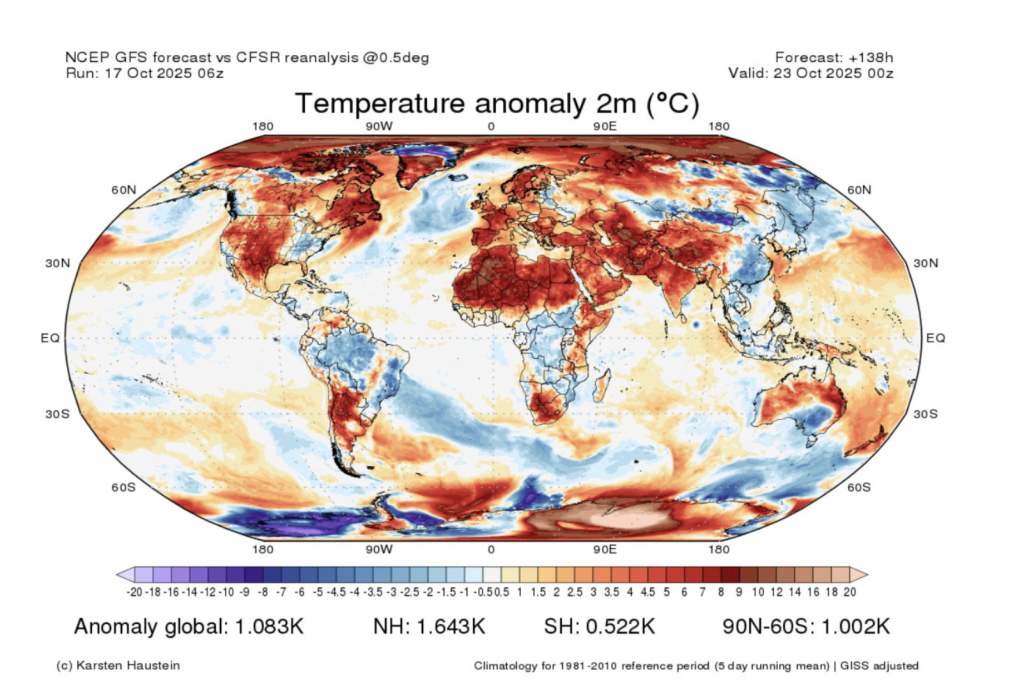
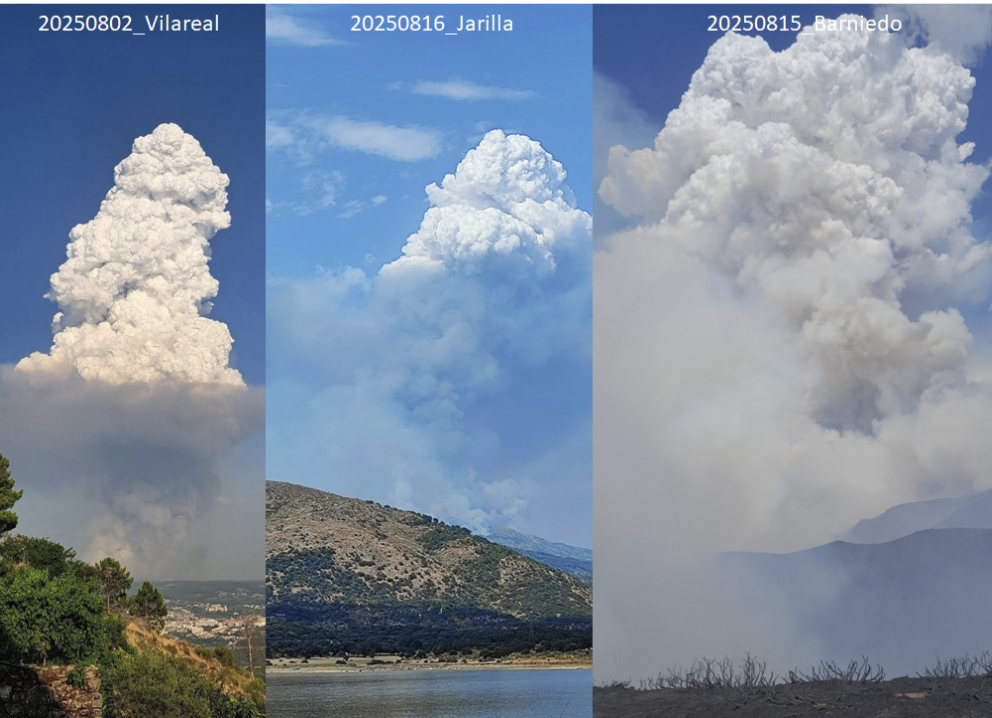
The wildfire problem is no longer a localised issue; it is a global atmospheric and societal crisis. As David Caballero noted, the anomalies of 2023 and the continued warming recorded through late 2025 are undeniable facts that have shifted the paradigm of fire behaviour. We are now witnessing pyroconvective columns—massive fire-atmosphere interactions where the blaze creates its own weather patterns, moving faster and with more energy than ever before, leading to violent and unpredictable fire behaviour.
This escalation is driven by a dangerous intersection of factors:
– Rural Abandonment: The abandonment of agricultural activities has allowed unmanaged vegetation to reclaim former croplands, creating a continuous “fuel bridge” from the wilderness directly into populated villages.
– System Overload: These fires have reached scales that overwhelm traditional firefighting capabilities, regardless of national resources or international cooperation.
– Urban Air & Health: Beyond the flames, the massive production of smoke travels across continents, creating a long-range health crisis for urban populations far from the fire front.
Multiscale Physics: From Landscapes to Urban Structures
The primary challenge in wildfire modelling is the sheer range of scales involved. HiDALGO2 addresses this through a nested approach that bridges the gap between massive territorial shifts and the micro-scale physics of a burning home.
At the Landscape Scale (Macro), simulations cover hundreds of kilometres using EuroHPC resources like the LUMI supercomputer. The focus here is on the formation of pyroconvective columns, smoke production and dispersion, tracking their movement across borders to assess health impacts on distant urban centres.
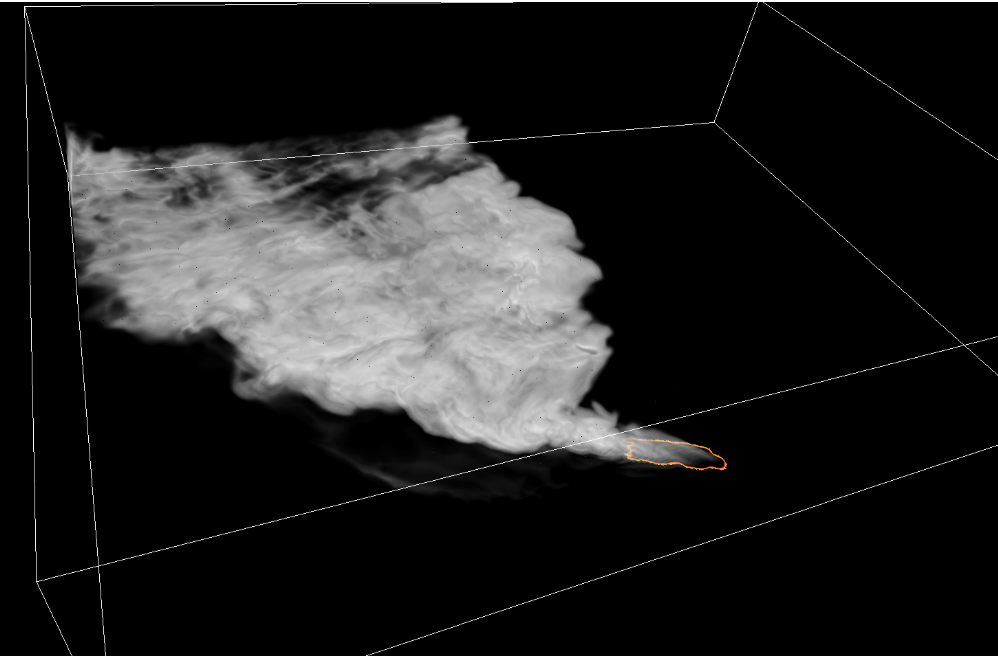
Transitioning to the micro-scale and the Wildland-Urban Interface (WUI), the pilot utilises Computational Fluid Dynamics (CFD) to model exactly how fire and smoke interact with specific architectural structures and local vegetation.
Key technical pillars of this approach include:
– Advanced Solvers for high-precision simulations: Utilising PIMPLE for air movement and pressure, fireFoam for turbulent flame diffusion and PorousGasificationFoam to simulate how hedges and garden trees act as fuel sources.
– Vegetation Digital Twins to support decision-making: Moving beyond static maps, the team employs generative AI and procedural sprawling to simulate how vegetation evolves over the years.
By applying fractal sampling, the model accounts for the precise biomass and moisture content of individual plants. This allows researchers to project the landscape’s “fire proneness” decades into the future, helping policymakers decide where to thin forests or reinforce infrastructure before a fire even starts.
– Immersive Training & Risk Awareness: To bridge the gap between complex data and human decision-making, HiDALGO2 integrates these simulations into Virtual Reality (VR). Using Gaussian Splatting—a technique that creates high-fidelity 3D scenes from photos—combined with CFD data, the project provides firefighters with realistic, real-time training environments. This allows personnel to “experience” the optical effects of smoke and heat radiation in a safe, controlled setting.
Impact and the Road Toward Real-Time Simulation
The work of the HiDALGO2 Wildfire pilot offers tangible benefits that bridge the gap between high-level research and societal safety. By identifying landscape “hotspots,” the pilot enables targeted prevention and informs policy directives for fire-resistant urban planning.
Specifically, by accurately modelling smoke dispersion and fire spread in the WUI, the pilot directly contributes to early-warning systems and public safety in regions such as the Mediterranean, which has seen devastating losses in recent years. The team has organised and participated in several training sessions with firefighters, not only in industry meetings and events, but also online and in regions like Castilla-La Mancha.
The pilot is currently moving toward surrogate modelling. By training neural networks on high-fidelity simulations, the team aims to create “demonstrators”—lightweight tools that provide nearly instantaneous results without requiring massive computational overhead. This will allow technical staff—who may not be HPC experts—to explore “what-if” scenarios instantly on standard hardware.
Furthermore, efforts focus on integrating diverse data sources, ensuring that the models remain adaptive to real-time atmospheric changes observed during the record-breaking fire seasons of 2023 and 2025.
This transition from “brute force” numerical simulation to AI-assisted prediction is paving the way for faster, more efficient models that reduce the computational bottleneck of moving massive datasets; this is essential for providing the quick responses demanded by modern, high-intensity fire seasons.
Stay Connected with HiDALGO2: LinkedIn | X (Twitter) | Facebook | Website
Subscribe to our newsletter and explore the latest issues
This article was curated and designed by the Future Needs team, leading the Dissemination, Exploitation, and Impact Creation work for HiDALGO2. Kyriaki Daskaloudi and Georgia Nikolakopoulou managed the organisation of the Stuttgart Clustering Event, produced the video presentation, and designed the visual strategy for the project.