
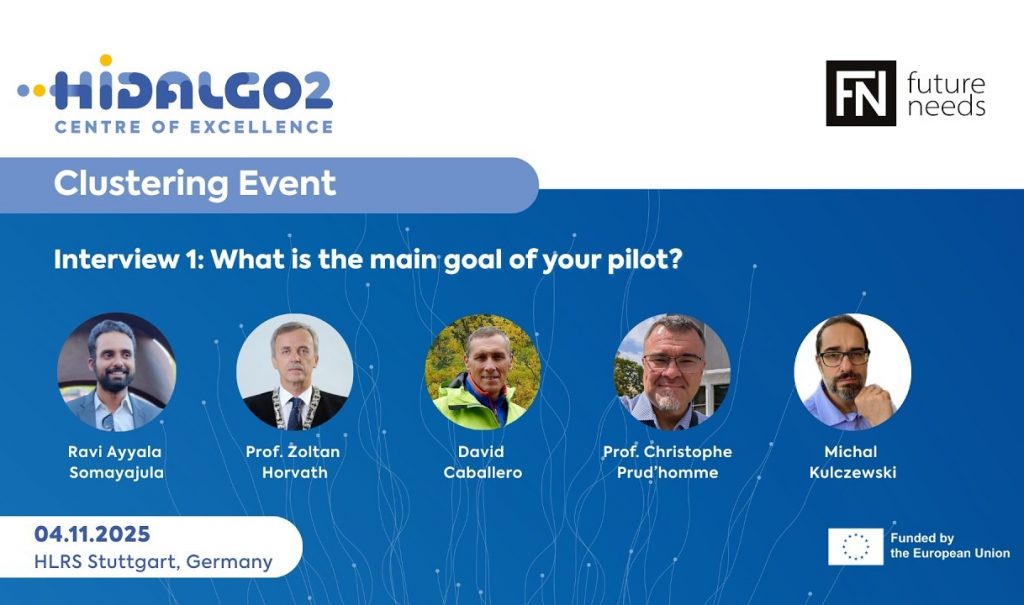
High-Performance Computing (HPC) is often discussed in terms of raw power—nodes, cores, and floating-point operations. But at the recent HiDALGO2 Clustering Event at HLRS in Stuttgart, the conversation shifted from the how to the why.
Through the five HiDAGLO2 pilots, our researchers are turning massive datasets into actionable tools for a safer, more sustainable world. During a series of on-site interviews conducted by our dissemination leader, Future Needs, the leaders of our pilots shared a common goal: to build trust through reproducibility and translate complex simulations into real-world impact.
Material Transport in Water (MTW): Simulating Pollution Transport in Rivers
Ravi Ayyala Somayajula, from Friedrich-Alexander-Universität Erlangen-Nürnberg, explained that the MTW pilot sits at the vital intersection of environmental protection and engineering. Ravi explained:
“MTW is mainly focusing on sediment transport simulations, which essentially are particle simulations transported in water…Studying how sediment is eroded and transported in water bodies is essential for geologists, civil engineers, and also it impacts the quality of water, which is essential for aquatic life as well.”
By utilising HPC resources to tackle these environmental issues, the pilot provides essential data for hydraulics, dam construction, and coastal engineering, ensuring that human infrastructure and aquatic ecosystems can coexist safely.
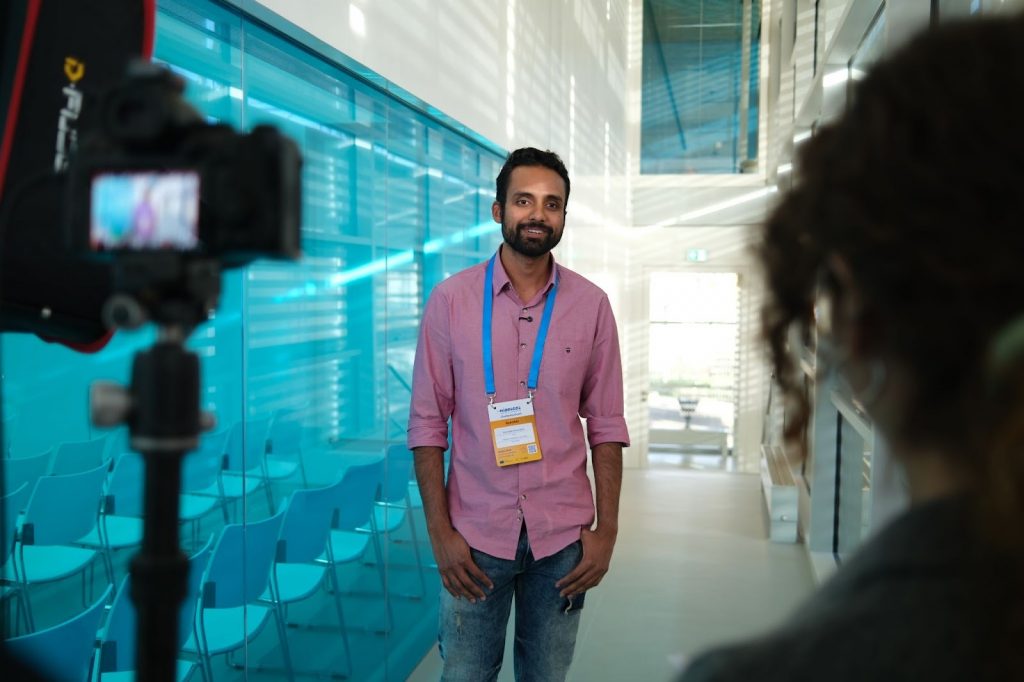
Ravi Ayyala Somayajula interviewed by Kyriaki Daskaloudi (Future Needs), in HLRS premises
Urban Air Pollution (UAP): Breathing Easier in the City
When it comes to the air we breathe in our cities, resolution is everything. Prof. Zoltan Horvath, from the University of Győr, presented the UAP pilot’s incredible ability to compute urban airflow at a granularity never seen before.
“We compute for a huge domain, like five kilometres by five kilometres of a city under one meter resolution,” Prof. Horvath noted.
By collaborating with the city of Stockholm and the Swedish Competence Center (ENCCS), the team used high-accuracy shapefiles to simulate domains far larger and more detailed than current city-planning tools allow. This “Digital Twin” approach allows planners to visualise pollutant dispersion with surgical precision, leading to healthier urban design.
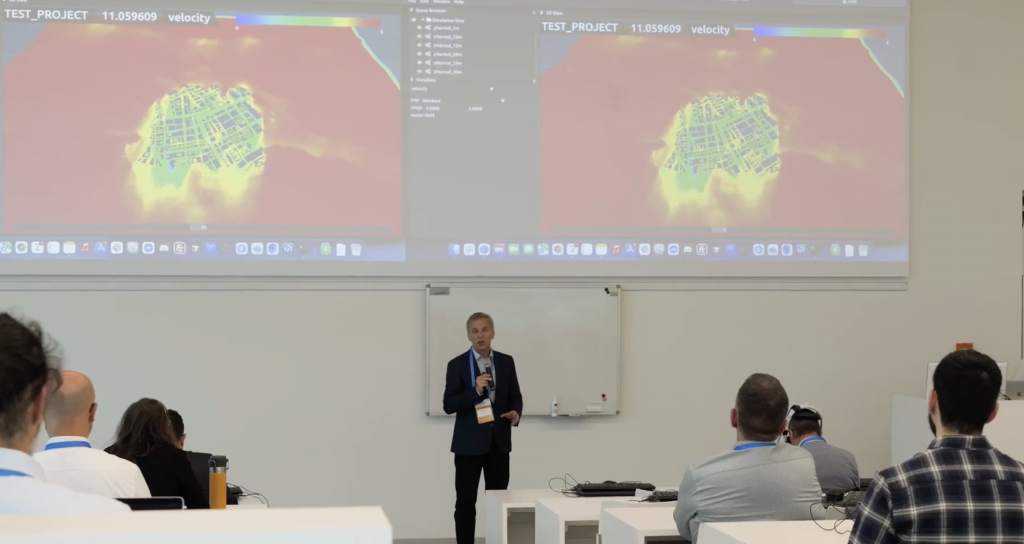
Zoltan Horvath presenting the Stockholm Success Story
Wildfire Interaction: Anticipating the Unpredictable
As climate change intensifies, wildfires are becoming more volatile. David Caballero, from MeteoGRID, highlighted the pilot’s focus on the complex interaction between forest fires and the atmosphere.
“We are trying to go a step forward… providing some robust numerical simulation of these wildfire-atmosphere interactions in these climate change scenarios,” David shared.
The goal isn’t just data; it’s safety. The wildfires pilot provides tools for firefighters to understand fire processes in real-time, but it also looks toward the future. By using “Serious Games” and Virtual Reality goggles, the project allows the population and first responders to see this complexity intuitively. “Our goal also is for training for the firefighters and for risk awareness for the population,” David added.
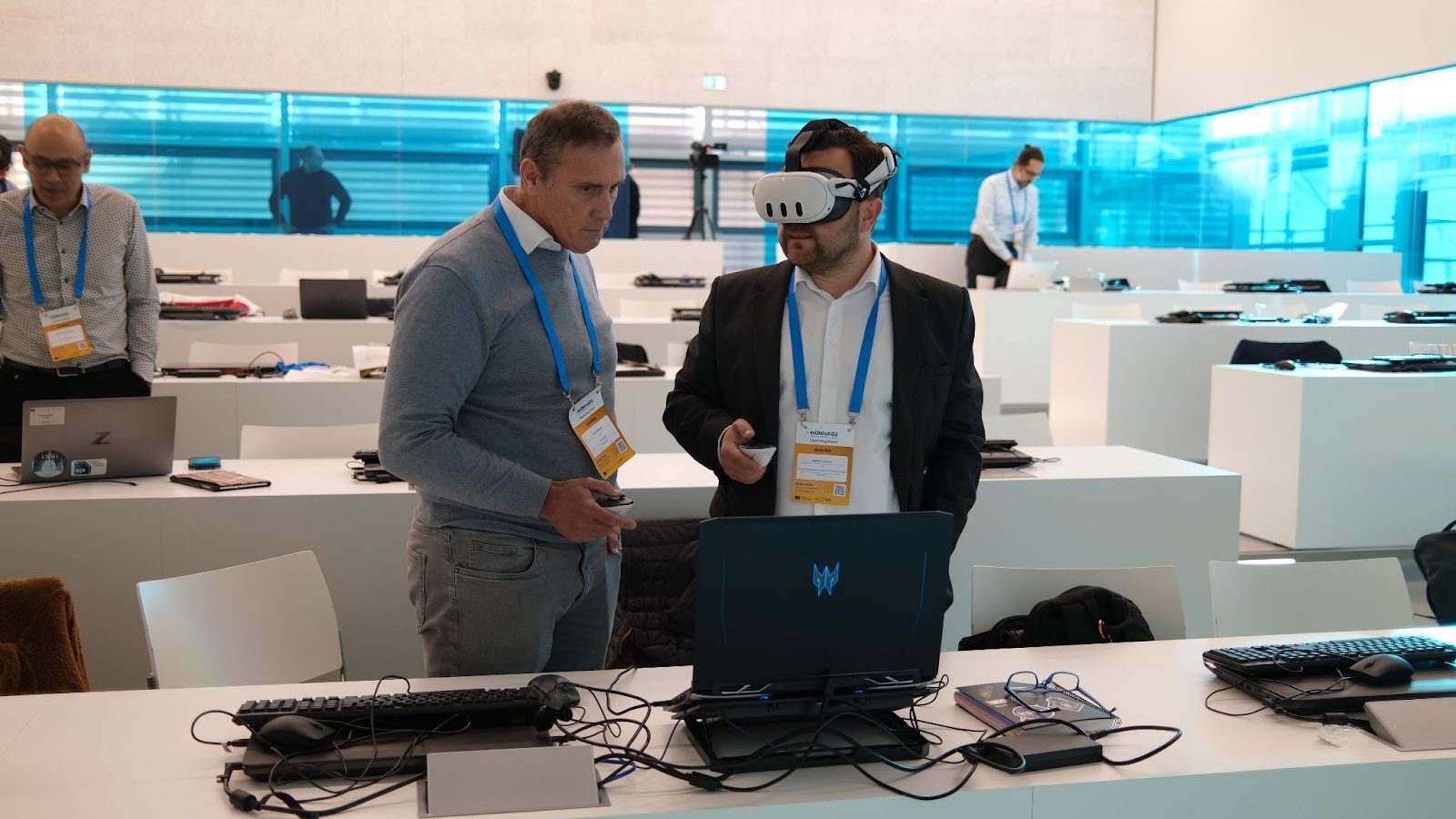
David Caballero, with the project coordinator, Marcin Lawenda, testing the VR application of the Wildfires Simulation
Ktirio: Building-to-City Scale Energy Efficiency
Prof. Christophe Prud’homme, from the University of Strasbourg, introduced Ktirio, a tool that scales energy simulation from a single room to an entire metropolitan area.
“Ktirio allows you to compute energy, comfort, and indoor air quality indices at the building level, from the building level to the city level,” Christophe explained.
The breakthrough here is the speed and reliability of the pipeline. By automating the journey from map to simulation to KPIs, the pilot ensures that urban transformation is backed by data that is “reproducible and traceable.” Christophe emphasised that this is essential to providing “trust through the simulation that we do.”
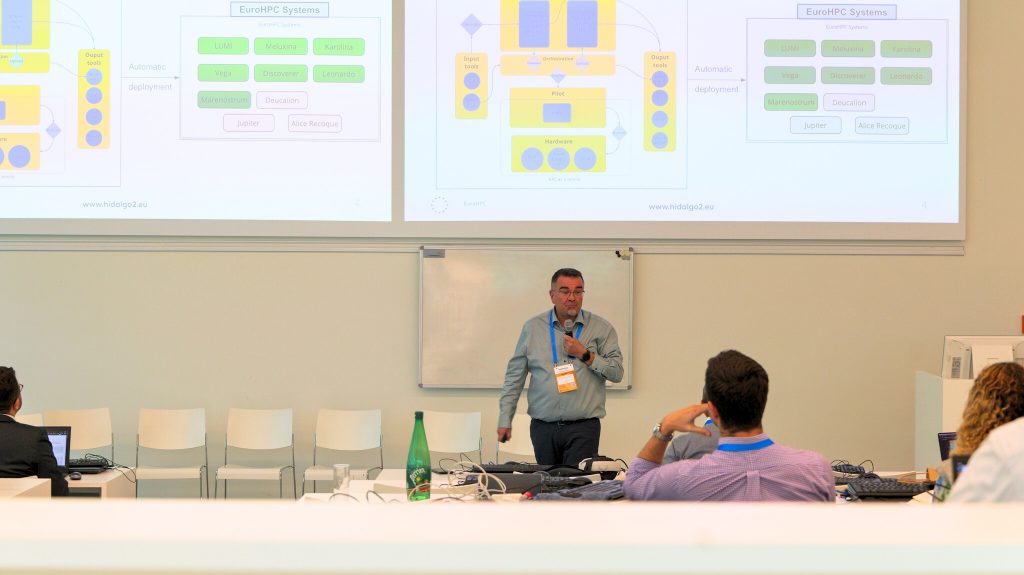
Christophe Prud’homme presenting the architecture of the Ktirio pilot
Renewable Energy Sources (RES): Stabilising the Green Grid
Finally, Michal Kulczewski (Poznan Supercomputing and Networking Center) discussed the challenge of the energy transition. The RES pilot aims to stabilise the energy grid itself, by providing the foresight needed to manage the variable nature of green energy, to be more stable and reliable.
“What we are contributing beyond the state-of-the-art is an AI-based model responsible for finding the correlation between weather conditions and the amount of electricity being produced from renewables.”
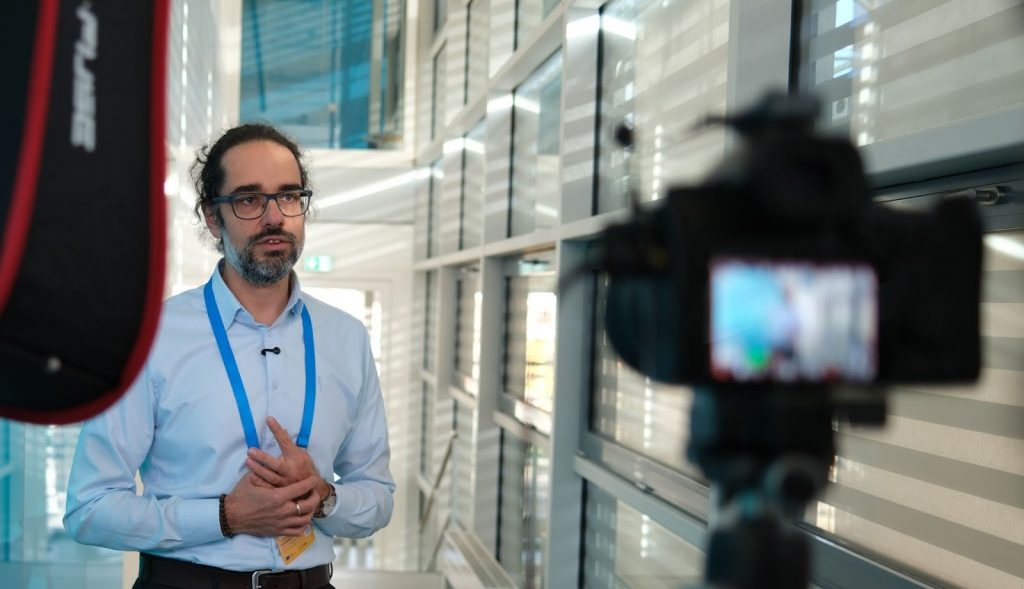
Michal Kulczewski, being interviewed by Chris Aguilar (Future Needs)
As these pilots move toward Exascale readiness, the mission remains the same: science in service of society. Whether it’s a firefighter on the front lines in Spain or a city planner in Stockholm, HiDALGO2 is providing the maps needed to navigate a changing planet.
Through the ongoing HiDALGO2Insights campaign, managed by Future Needs, we will continue to share these breakthroughs, ensuring that the results of the European HPC infrastructure reach the stakeholders who can turn them into action.
Watch the full video of the interviews with the experts below.
Stay tuned!
Follow us on LinkedIn, X and BlueSky to be up to date with our latest activities.