
This article was authored in Polish by Małgorzata Szołucha, and published on April 28, 2026 on NCBR
In a world where climate change, severe weather events, and energy transformation are becoming civilizational challenges, science capable of understanding and predicting them is increasingly important. Supercomputers, artificial intelligence, and advanced numerical simulations are coming to the rescue. The HiDALGO2 project, one of the European Centres of Excellence (CoEs) funded by the EuroHPC Joint Undertaking and national funds, operates at the intersection of these fields.
This ambitious undertaking, coordinated by the Poznań Supercomputing and Networking Centre (PSNC), brings together nine partners from seven European countries. The consortium aims to create tools that will enable a better understanding and more effective management of complex environmental and social phenomena. The project combines the potential of HPC ( High-Performance Computing ), Big Data, and AI to support global efforts for sustainable development.
“HiDALGO2 is an example of science that truly addresses contemporary challenges. Thanks to the power of supercomputers and intelligent data analysis, we can not only better understand environmental processes but also predict their effects before they are felt by people and the economy,” emphasizes Dr. Marcin Lawenda, project coordinator.
The HiDALGO2 project focuses on providing solutions to so-called Global Challenges. These encompass phenomena of enormous scale and complexity, such as air pollution, building energy efficiency, renewable energy sources, forest fires, and the spread of pollutants in the aquatic environment. The PSNC research team and project partners create numerical simulations and predictive models that run on hundreds of thousands of CPU cores and dozens of GPU accelerators in Europe’s largest HPC centres, such as LUMI in Finland, LEONARDO in Italy, MareNostrum 5 in Spain, and Discoverer in Bulgaria. Harnessing such powerful resources enables simulations with unprecedented accuracy, encompassing both local and global scales of environmental processes.
The exascale era is coming
HiDALGO2 is a project pushing the boundaries of computing technology. The consortium is developing and testing solutions that prepare research applications for the exascale era—capable of performing trillions of operations per second. In practice, this means optimising source code, implementing co-design methods (software co-designed for a specific hardware architecture), automating deployment and testing in CI/CD systems, and ensuring application portability across different HPC environments through containerisation.
The PSNC team is responsible for, among other things, developing one of the pilot applications (RES), benchmarking, developing computational orchestration tools (QCG Workflow Orchestrator ), and integrating components within the project’s shared infrastructure. This is where solutions are developed that enable simultaneous management of complex environmental simulations, their visualisation, and real-time analysis of results.
Use Cases
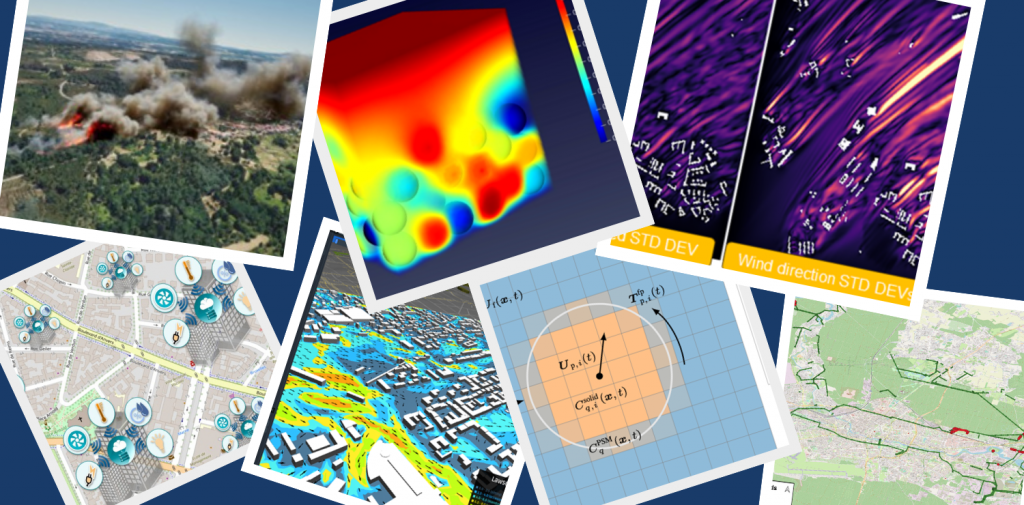
HiDALGO2 focuses its research on five use cases that utilise computational fluid dynamics (CFD ) simulations. These include modelling urban air quality, energy efficiency of urban development, forecasting renewable energy production, forest fire simulations, and studies of sediment and pollutant flow in rivers and reservoirs. Each of these use cases is developed by specialised teams of scientists from different countries, and their work is connected by a common infrastructure of data, tools, and visualisations developed by PSNC and the project partners.
Case 1: Urban Air Project (UAP)
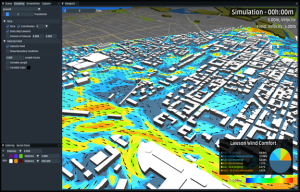
This use case focuses on high-resolution modelling of the urban microclimate, taking into account phenomena such as air pollution dispersion, pedestrian wind comfort, and urban planning processes. The project utilises traditional CFD models, order reduction methods (e.g., POD-DEIM), and artificial intelligence techniques. The model derives boundary conditions from global or regional meteorological simulations or sensor data, allowing it to be used in digital twins of cities. This allows UAP to serve urban decision-makers as a tool for spatial planning, scenario validation, and improving air quality and living comfort in urban areas.
Case 2: Urban Building Model (UBM)
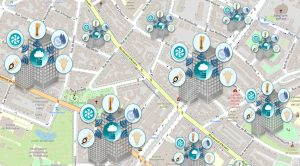
n this use case, the project focuses on advanced building models and their integration with urban infrastructure. The goal is to provide a model of heat, CO₂, and NOx emission sources for the city’s air quality model and improve the boundary conditions of the “external” UAP model. The model encompasses two levels: the building scale and the urban development scale. Input data includes GIS data, BIM data in IFC format, material properties, occupancy scenarios, weather data, and measurement data. The model supports, among other things, the assessment of energy consumption, thermal comfort, and air quality inside buildings, as well as the assessment of emissions and heat islands outside. Workflow automation is also a key element – leveraging CI/CD, containerization, and supercomputing platforms to ensure the tool is scalable and ready for real-world implementations.
Case 3: Renewable Energy Sources (RES)
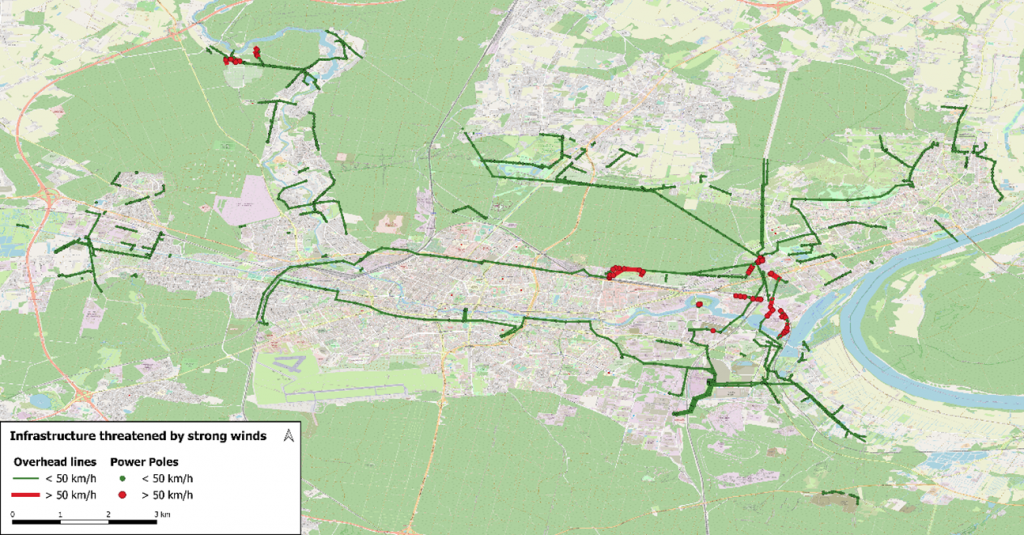
This use case involves estimating energy production from renewable sources, such as wind farms and photovoltaic installations, as well as predicting damage to renewable energy infrastructure. RES employs uncertainty quantification techniques and large-scale ensemble simulations to assess risk and performance under variable environmental conditions. This approach supports energy operators, planners, and decision-makers in understanding and optimising renewable energy systems under real-world conditions.
Case 4: Wildfires (WF)
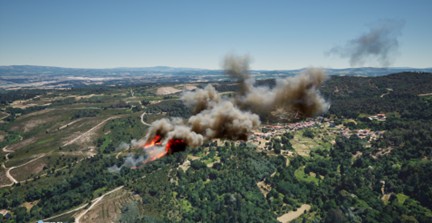
The “Wildfires” use case focuses on simulating the interaction between forest fires and the atmosphere, as well as smoke propagation, at various scales, from macro to micro. The goal is to create a computational environment that allows for the assessment of fire risk, its potential consequences, and its impact on the surrounding environment, particularly in forest-urban interface (WUI ) zones . Using HPC and advanced algorithms, it can support emergency management, spatial planning, and environmental protection services.
Case 5: Material Transport in Water (MTW)
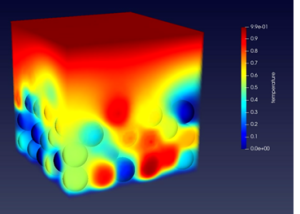
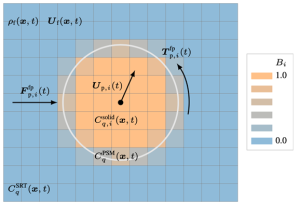
This use case focuses on advanced numerical simulations to better understand complex material transport processes (sediment, pollutants) in rivers and reservoirs. The model utilises hardware HPC multiphysics frameworks (e.g., waLBerla) and the C++ HyTeG framework for large-scale, high-performance simulations. This enables the development of pollution control and prevention strategies in aquatic environments, which is important for water conservation, water management, and environmental risk management.
Practical implementations
HiDALGO2 isn’t just about research—it also provides practical solutions. Models developed as part of the project are being tested in European cities: Győr, Illkirch, Poznań, and Stuttgart. They enable predictions of air quality in specific districts, analysis of building energy potential, and assessment of risks associated with heat waves or fires. In the future, similar models could be implemented in urban space management systems and data-driven energy planning.
One of the most impressive achievements of HiDALGO2 is the Urban Air Project, carried out in collaboration with SLB-analys (Stockholms Luft- och Bulleranalys), the unit responsible for monitoring air quality in the Swedish capital. The goal was to simulate airflow and wind comfort for the entire city, with a spatial resolution of 1-2 meters, which means analysing tens of millions of calculation points.
The task required significant computational power and exceptionally precise processing of geographic data. The RedSim solver, developed by a team at Széchenyi István University (SZE), was used for the calculations. It is a highly optimised CFD code that runs on hundreds of thousands of CPU and GPU cores, using MPI, SIMD/AVX512, and CUDA instructions.
Results are visualised in a browser using the proprietary CFDR tool, based on WebGL, enabling real-time rendering even on laptops with low computing power. These solutions enable the creation of realistic wind comfort maps, which help urban planners optimise the layout of buildings and public spaces – benefiting residents’ safety and quality of life.
Current and future tasks
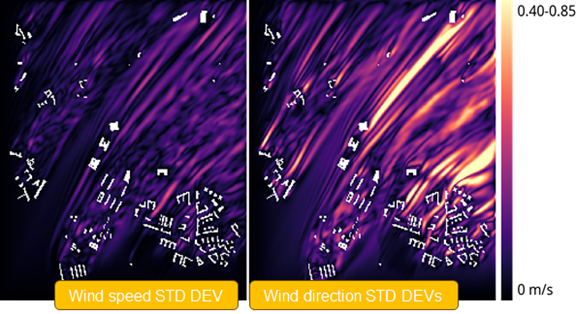
The 2024-2025 period brought dynamic progress in each of the project’s areas. Of particular note was the record-breaking scalability of the UAP-Xyst solver, which ran on nearly 200,000 cores on the LUMI-C supercomputer. The HiDALGO2 team also developed new models based on graph neural networks (GNNs) for analysing urban structures, PCA and deep learning for studying forest fires, and solar exposure mapping for forecasting renewable energy production.
The central HiDALGO2 Dashboard portal and a complete CKAN + HDFS + NiFi data management system, compliant with FAIR Data principles, have been implemented. Model uncertainty assessment methods and the mUQSA toolkit, enabling the analysis of multiple scenarios in parallel, have been developed. In the final year of implementation, the HiDALGO2 consortium is focusing on preparing for the practical implementation of its solutions, both in public administration and in the industrial sector.
The plans include further integration of artificial intelligence with large-scale simulations, development of tools for automating environmental analyses, and opening the project results to external users in the spirit of Open Science.
Training activities
The HiDALGO2 project’s educational activities are a crucial part of its mission, creating a space where science meets practice, and advanced computing technologies become a tool for understanding and protecting the environment. The project is developing a broad educational program, including workshops, courses, and hackathons focused on urban modelling, renewable energy forecasting, environmental data analysis, and HPC application optimisation.
Through collaboration with the CASTIEL2 initiative and the European CoE Academy platform, HiDALGO2’s knowledge and expertise reach thousands of researchers, engineers, and decision-makers across Europe. This gives HiDALGO2’s activities a practical dimension, connecting scientists with representatives from cities, industry, and governments, who learn how to use supercomputers to make data-driven decisions.
All training materials and tools developed within the project are openly available, supporting the idea of open science and the development of the European HPC community. In this way, HiDALGO2 not only creates groundbreaking technologies but also builds competencies and relationships that enable scientific innovations to be translated into tangible actions for people and the planet.
The importance of the project
The HiDALGO2 project is of exceptional importance to Poland. PSNC is the only institution in Poland to serve as the coordinator of the EuroHPC Center of Excellence under the Horizon Europe program. It is responsible not only for scientific and technical management but also for strategic coordination of work, partner integration, and maintaining a coherent project vision. The team, led by Dr. Marcin Lawenda, Eng., is responsible for preparing the technology roadmap, collaborating with other EuroHPC initiatives, and building synergies with other Centers of Excellence.
“Coordinating such a large undertaking is a huge responsibility, but also a unique opportunity to shape the European HPC landscape. For PSNC, it’s a sign of trust and confirmation of our position as one of the leaders in computing technologies in Europe,” emphasizes Dr. Lawenda.
Additional information
HiDALGO2 – High Performance Computing and Big Data Technologies for Global Challenges
Coordinating institution: Poznań Supercomputing and Networking Center
Project coordinator: PhD, Eng. Marcin Lawenda
Project website
Project profile in social media
Polish version on YouTube .