
RELEASE DATE: For immediate release · Madrid, 5 November 2026
From 3D forests to supercomputers: HIDALGO2 presents
next-generation wildfire simulation at the 10th International Conference on Forest Fire Research
MeteoGrid researchers showcase how game-engine technology and EuroHPC supercomputers can bring real tree architecture and real-time, physics-based visualisation into wildfire science.
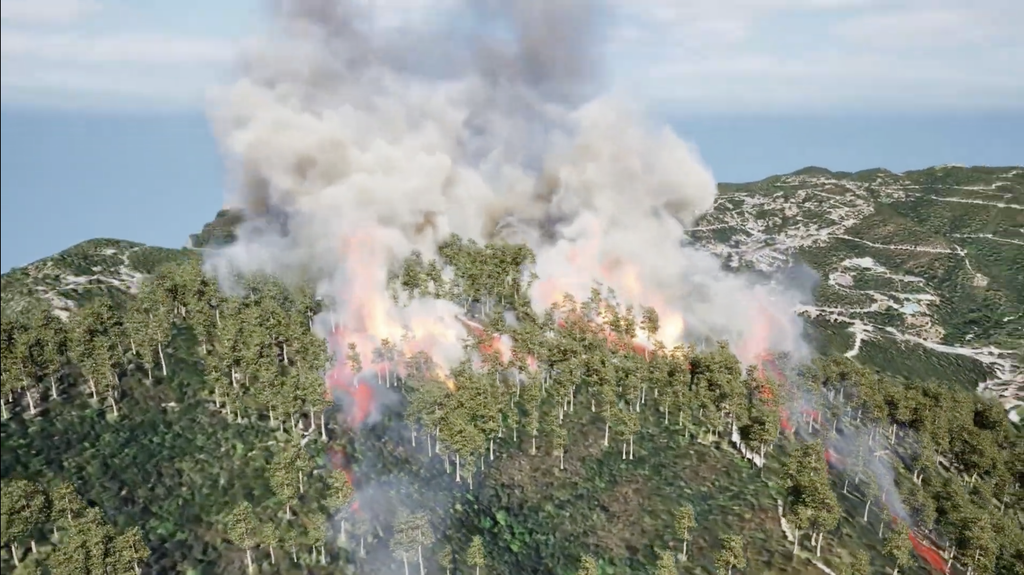
MeteoGRID, partner of the HiDALGO2 EuroHPC Centre of Excellence, presented two
contributions from the project at the 10th International Conference on Forest Fire
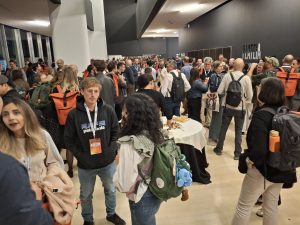
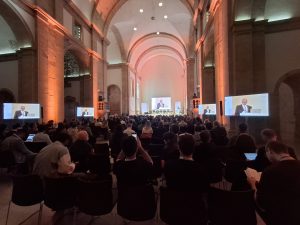
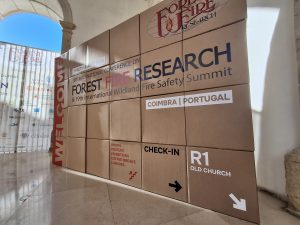
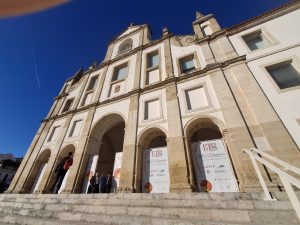
Research (ICFFR), held in Coimbra, Portugal, from 31 October to 6 November 2026.
The work connects procedurally generated 3D vegetation in Unreal Engine 5 with physics-
– based fire simulation in FDS/WFDS on the LUMI and MeluXina supercomputers, and brings
the results back into the game engine for real-time visualisation.
Preprints
MeteoGrid also contributed research on uncertainty in landscape-scale fire spread modelling and chaired a session on fire at the wildland-urban interface.
A tree in a fire model no longer needs to be a cone
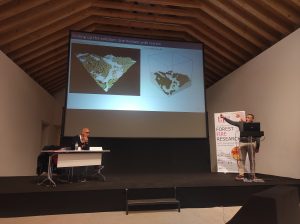
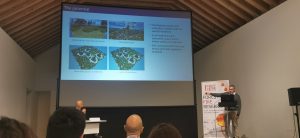
In the oral presentation From 3D vegetation models to physics-based wildfire simulation: a fractal barycentric method for Lagrangian particle initialisation in FDS/WFDS (session NET, 3 November), David Caballero addressed a long-standing limitation of wildfire models: tree crowns are usually represented as cylinders, cones or ellipsoids filled with uniform fuel. The method developed in HiDALGO2 uses the 3D geometry of each tree as its fuel map. The foliage mesh is recursively subdivided into sub-triangles whose barycenters mark the simulation cells that contain fuel, and one Lagrangian particle is placed in each occupied cell.
Because fuel bulk density and surface-to-volume ratio are properties of the species, the same parameters work from 5 cm resolution for a single tree to 50 cm for a landscape. The whole workflow runs from a native Unreal Engine 5 plugin, the FDS Vegetation Exporter, which generates the complete FDS case and the job script ready for EuroHPC systems.
Results presented include:
- A procedurally generated Norway spruce converted into 18,202 fuel cells (3.2 kg of dry
fuel) and burned on LUMI at 5 cm resolution - A one-hectare wildland-urban interface site at Rectoret (Barcelona), with real terrain
and 4,490 individually represented trees: 8 million cells on 640 MPI ranks on MeluXina
Every pixel of the fire comes from the simulation
The digital video poster Real-Time Physics-Based Visualisation of FDS/WFDS Simulations in
Unreal Engine 5 Using Sparse Volume Textures presented the visualisation side of the HiDALGO2 pipeline. FDS smoke and temperature fields are converted to OpenVDB on the same supercomputer where the simulation runs, and rendered in real time in Unreal Engine 5: soot density controls how the smoke blocks light, and gas temperature controls the colour of the flames.
The result is a visualisation that is both physically grounded and visually convincing, with no manual artistic intervention. The poster also showed fire volumes composited over real-world scenes reconstructed from drone imagery, a direct application for training, risk communication and the analysis of wildland-urban interface scenarios. The visualisation work drew strong interest from researchers and practitioners throughout the conference.
Uncertainty at landscape scale and a session on the wildland-urban interface
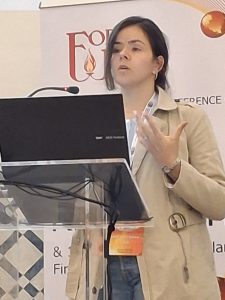
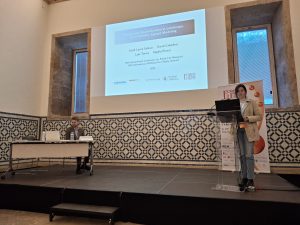
Leydi Laura Salazar, researcher at MeteoGrid, presented Uncertainty Quantification in
Landscape-Scale Wildfire Spread Modelling: An Ensemble Approach Using WRF-SFIRE and
a Reduced-Complexity Fire Spread Engine (RAS_32, 3 November). Her work addresses how much confidence can be placed in fire spread predictions at landscape scale, complementing the detailed, interface-scale simulations of HiDALGO2: from the atmosphere to the individual tree.
At the invitation of the conference chair, Professor Domingos Xavier Viegas, David Caballero chaired the session on Fire at the Wildland-Urban Interface on 4 November, with four presentations on wildfire interaction with infrastructure, community-scale fire transfer, crown fire ignition and flame spread scaling with FDS.
New collaborations for validation
The conference opened new lines of collaboration to validate the HiDALGO2 methods against experimental data. Discussions were initiated with research groups in Europe and the United States, including the U.S. National Institute of Standards and Technology (NIST), to compare simulated tree fires with near-field heat flux measurements, and with researchers working on UAV LiDAR to validate the simulated distribution of biomass in vegetation.
“For decades, fire models have had to simplify trees into geometric shapes. With HIDALGO2 we can now take the real architecture of a forest, burn it with full physics on a European supercomputer and see the result in real time. The response in Coimbra confirms that this combination of simulation and visualization is where the field is heading.”
— David Caballero, MeteoGrid
Next steps include validation against experimental tree burns, LiDAR-based vegetation, and the public release of the conversion tools in the HiDALGO2 repository.
About HiDALGO2
HiDALGO2 is a EuroHPC Centre of Excellence that applies high-performance computing to global environmental challenges, with wildfires as one of its main use cases. More information: https://hidalgo2.eu.
MeteoGRID is a Madrid-based company specialised in high-fidelity environmental and meteorological modelling. It has operated the SIMMER decision-support platform for ten years.
Contact: David Caballero, MeteoGRID · david@meteogrid.com
HiDALGO2 partners
Poznań Supercomputing and Networking Centre (PSNC) – Coordinator
High-Performance Computing Centre Stuttgart (HLRS)
Széchenyi István University (SZE)
Centre for Modelling and Simulation in Strasbourg (Cemosis)
Institute of Communications and Computer Systems (ICCS)
Future Needs Management Consulting Ltd (FN)
DISCLAIMER
Co-funded by the European Union. This work has received funding from the European High Performance Computing Joint Undertaking (JU) and Poland, Germany, Spain, Hungary and France under grant agreement number: 101093457.
Views and opinions expressed are however those of the author(s) only and do not necessarily reflect those of the European Union or the European High-Performance Computing Joint Undertaking (JU) and Poland, Germany, Spain, Hungary, and France. Neither the European Union nor the granting authority can be held responsible for them.
