

In a collaborative effort between HiDALGO2, SLB-analys, and ENCCS, researchers have developed a scalable HPC solution to simulate wind patterns across the entire city of Stockholm at unprecedented resolution.
The Challenge
Wind in urban environments significantly impacts inhabitant comfort and safety. Tall buildings can create “wind tunnels” where speeds far exceed averages, potentially putting pedestrians at risk. To optimize urban development, city planners need to evaluate construction plans under various weather scenarios.
However, simulating an entire city (100 km²) at a 1-2 meter horizontal resolution presents massive challenges:
- Geometry: Combining complex building and terrain data.
- Computation: Requiring massive HPC resources for high-resolution CFD.
- Visualisation: Handling terabytes of simulation data on standard office hardware.
The Solution: RedSim and CFDR
To solve these issues, the EuroCC National Competence Center Sweden (ENCCS) connected SLB-analys (the Environment and Health Administration of the City of Stockholm) with the HiDALGO2 team at Széchenyi István University (SZE) in Hungary.
The SZE team adapted their HiDALGO2 Urban Air Project (UAP) toolset for the Stockholm use case:
- Preprocessing: The RedSim-Preproc-Urban toolbox processed precise GIS building and terrain data (isolines 0-90 m) into valid 3D computational meshes using Gmsh.
- Simulation: The RedSim solver – a highly optimised multi-GPU CFD engine – executed the heavy lifting.
- Visualisation: To enable remote access, the CFDR tool was used to render raw (CFD-related) 3D data residing on the HPC platform, in real time, directly, in a web browser, allowing SLB-analys staff to view results on standard laptops.

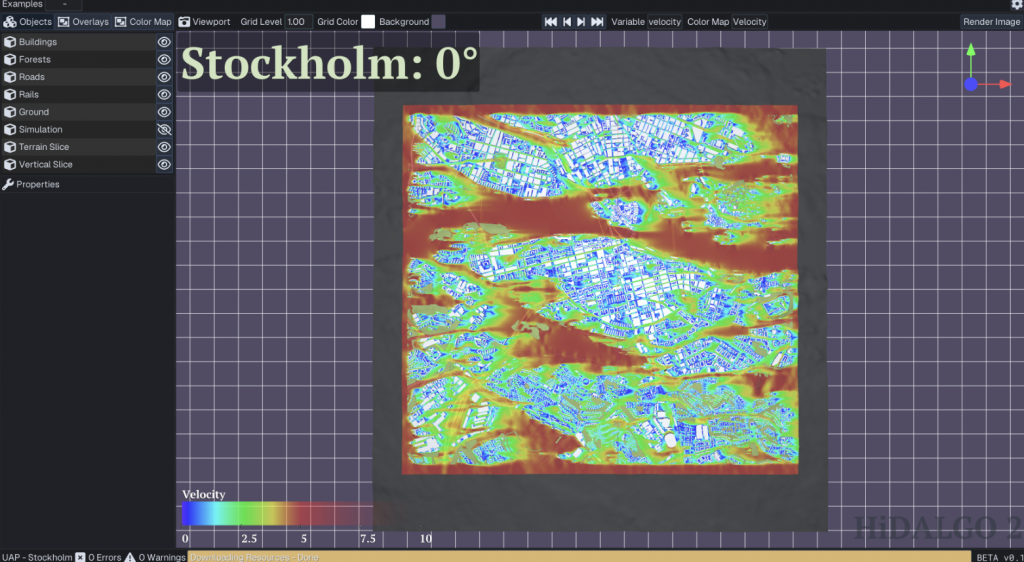
Figure 3: Results of a scenario analysis: visualisation of the wind magnitude on a surface of 2 meters height from the ground
The team recently released a BETA version of a user-friendly interface for non-technical users for the city of Stockholm.
Impact and Benefits
This workflow provides city planners and policymakers with fast, high-resolution wind data to guide sustainable urban development. The efficiency gains are significant:
- Precision: The city’s computational model was generated based on precise terrain and building GIS data
- Scalability: RedSim scales up to 512 CPU nodes and 32 GPUs, which allows high-resolution simulation of an entire urban district with complex terrain.
- Speed: Generating a city model (at 2,5 metres resolution) takes less than 15 minutes; surface meshing takes 6-8 hours; 3D meshing takes 15 minutes; a full wind scenario simulation takes just 15 minutes on 12 HPC nodes of an HPC machine. Time-to-solution becomes hours for city planners, for large-scale scenario analysis, which is not available with other solvers.
- Accessibility & Reduced Costs: Optimised HPC and web-based tools reduce the need for physical testing, expensive local hardware or third-party software, saving time and resources.
- Commercial Potential: There is a commercial potential toolchain, comprised of the scalable CFD engine (RedSim) and visualisation tool (CFDR), together with the geometry pre-processing tools (RedSim-Preproc-Urban), which can be offered as commercial services or licensing models for environmental consultancies, city authorities, or industry partners.
This innovative GIS and terrain data process, together with the scalable HPC-backed CFD solution, created a showcase for other large-scale urban areas.
More about the partners
SLB Analys
Stockholms Luft-och Bulleranalys (SLB-analys) is a unit at the Environment and Health Administration of the City of Stockholm. The unit is responsible for monitoring outdoor air quality in the city. SLB-analys also runs the regional system of air quality monitoring on behalf of the East Sweden Air Quality Management Association (Östra Sveriges Luftvårdsförbund) and assists its municipalities with services including measurements and model calculations. The basis for the construction of the computational geometry of the CFD model of the city was a data set provided by SLB-analys.
ENCCS
The EuroCC National Competence Centre Sweden (ENCCS) provides high-performance computing training and support for industry, academia and public administration for free. ENCCS can guide their partners before, during and after they have gotten access to high-performance computers by providing useful know-how, best practices, as well as hands-on support for your code.
SZE
The HiDALGO2 partner Széchenyi István University (SZE) is located in Győr, Hungary, in a centre of an industrial region. In HiDALGO2, SZE is developing the Urban Air Project (UAP) and leads the work package for the applications. The SZE-team is led by the mathematician Prof. Zoltán Horváth, and includes a professional scientific programmer and computer scientists, all working for several decades in the field of HPC.
Contact: Zoltán Horváth (SZE) – horvathz@sze.hu
The team working on this pilot under the supervision of Zoltán Horváth includes Kornyei Laszlo, Mátyás Constans, Jozsef Bakosi, Áron Németh, Ádám Hunyadvári (SZE)
This pilot was supported by the EuroCC 2 and CASTIEL 2 Consortia and published in the NCC/CoE Booklet 2025.